

-
Vinoth
- Posted on
- Categories:General
- 0 comments
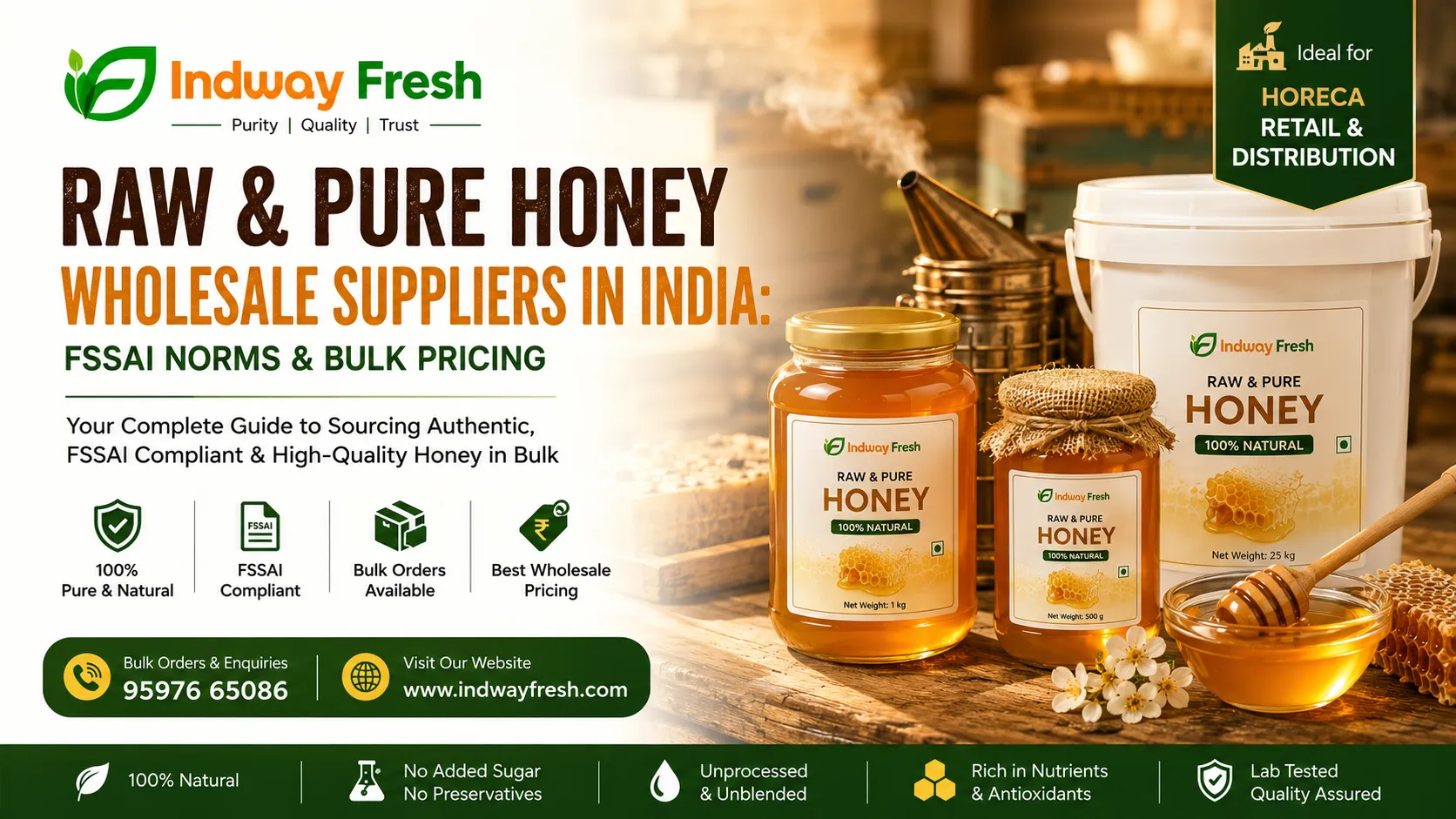
1. Who Buys Honey in Bulk, and Why Purity Matters More Here
Honey sits at an unusual intersection in the wholesale food ingredient market — it’s bought by Ayurvedic and herbal medicine manufacturers, skincare and cosmetic brands, F&B businesses formulating drinks and desserts, and retailers stocking their own shelves. Each of these buyers is relying on the same underlying claim: that what’s in the drum is actually honey, and not honey cut with sugar syrup.
That claim carries more scrutiny in India than in most other bulk food categories, because honey has been at the centre of repeated adulteration investigations over the past several years — samples from a number of major Indian brands have failed advanced authenticity testing in independent studies, even while passing the government’s standard tests. For a B2B buyer, that history changes the sourcing conversation: purity verification isn’t a nice-to-have on a honey supplier’s page, it’s the first thing to check.
2. FSSAI Norms: What Honey Adulteration Testing Actually Covers
Honey is regulated in India under the FSSAI’s food safety standards, and it’s one of the most tested-for-adulteration commodities in the country’s food supply. A supplier’s compliance claims are only meaningful if they can point to which of these parameters they actually test for:
| Test / Parameter | What it detects |
|---|---|
| Moisture content | Excess moisture affects shelf life and can indicate premature harvesting or dilution |
| HMF (Hydroxymethylfurfural) | Indicates overheating or aging of the honey |
| Diastase activity | Enzyme activity level — a marker of freshness and improper processing |
| C3/C4 sugar ratio (IRMS) | Detects adulteration with cane or corn syrup (C4 sugars) and rice or beet syrup (C3 sugars) |
| SMR (Specific Marker for Rice syrup) | A test mandated in India specifically to catch rice-syrup adulteration, a common and harder-to-detect method |
| NMR (Nuclear Magnetic Resonance) | An advanced global-standard authentication test; not mandated by FSSAI but increasingly used by export-focused and premium suppliers |
What to actually ask a supplier
- Do you test every batch, or only periodically?
- Can I see a current Certificate of Analysis (CoA) for the specific batch I’m buying?
- Is the SMR (rice syrup) test part of your standard testing, given how common that adulteration method is?
- Is your facility FSSAI-licensed, and do you hold any additional certification (ISO 22000/HACCP)?
3. Bulk Pricing: What Drives the Rate
Honey pricing in India varies by floral source/varietal (multiflora, mustard, sunflower, berry, and others), processing (raw vs. heat-processed/filtered), and order volume. As a reference point, a 30kg commercial can of raw honey from an established Indian wholesale supplier is currently priced at around ₹3,700 (excluding GST and shipping) — useful as a general market anchor, though exact rates will vary by supplier, varietal, and current season.
| Factor | How it affects price |
|---|---|
| Floral source/varietal | Single-origin or seasonal varietals (e.g. berry, mustard) often carry a different price than standard multiflora honey |
| Raw vs. processed | Raw, minimally filtered honey is typically positioned and priced differently from heat-treated, clarified honey |
| Order volume/can size | Commercial cans (15–30kg) generally offer better per-kg economics than retail jar multiples |
| Testing & certification level | Suppliers offering NMR-level authentication or export-grade documentation may price at a premium over standard FSSAI-compliant supply |
| Custom packaging / private label | Custom jars, labels, or contract packing typically add a per-unit cost over standard packaging
|
4. Pack Sizes and MOQ for B2B Buyers
Wholesale honey suppliers in India typically structure their range to serve both small retailers and larger industrial buyers:
| Pack format | Typical buyer |
|---|---|
| 300g retail jars (sold in case packs) | Retailers, small D2C brands stocking shelf-ready units |
| Mid-size commercial packs | Cafés, bakeries, small-batch F&B producers |
| 15–30kg commercial cans | Ayurvedic/herbal manufacturers, cosmetic formulators, large-scale F&B production, private-label brands |
Most wholesale honey suppliers set a minimum bulk order value rather than a minimum unit count, so it’s worth asking whether your target order clears that threshold before requesting a formal quote—and whether custom pack sizes or private labeling is available at your volume.
5. Supplier Evaluation Checklist
- Can they provide a current, batch-specific Certificate of Analysis?
- Do they test for rice-syrup adulteration (SMR), not just the basic FSSAI panel?
- Are they FSSAI-licensed, and ideally ISO 22000/HACCP-certified?
- What’s their minimum bulk order value, and does it fit your volume?
- Do they support private labelling or contract packing if you’re building your own brand?
- What’s their delivery reach, and how quickly can they dispatch PAN India?
- How is the honey stored and shipped — sealed, moisture-protected, away from heat?
6. Sourcing from Indway Fresh
Indway Fresh supplies pure honey to B2B buyers—including Ayurvedic and herbal health manufacturers and skincare/cosmetic and personal care companies—in pack sizes from 300g retail jars up to 30kg commercial cans, with custom pack sizes, private labeling, and contract packing available. The minimum bulk order value is ₹10,000. Honey is manufactured and packed at the company’s Madurai facility, with fulfillment warehouses in Chennai, Bangalore, and Hyderabad supporting PAN India delivery. Shelf life is 6 months to 1 year from the date of manufacture when stored correctly—honey itself doesn’t spoil, though it may crystallize or darken over time.
FAQs
What is the minimum order for bulk honey?
This varies by supplier — some set it by order value rather than unit count. Indway Fresh, for example, sets a minimum bulk order value of ₹10,000, with pack sizes from 300g retail jars to 30kg commercial cans.
How can I verify that wholesale honey is pure and not adulterated?
Ask for a current, batch-specific Certificate of Analysis covering moisture, HMF, diastase activity, and the C3/C4 sugar ratio at minimum—and specifically ask whether the SMR test for rice-syrup adulteration is included, since that’s one of the harder adulteration methods to catch with basic testing.
Does honey expire?
Properly stored pure honey doesn’t spoil, though it may crystallize or darken over time. Most suppliers list a shelf life of 6 months to 1 year from the manufacture date as a quality guideline, not a hard expiry.
What’s the difference between raw and processed honey?
Raw honey is minimally filtered and not heat-treated, retaining more of its natural enzymes and pollen content. Processed/filtered honey is typically heat-treated and clarified for a longer shelf life and consistent clarity, at some cost to its raw nutritional profile.
Can I get private-label honey packaging for my own brand?
Yes—many wholesale honey manufacturers, including Indway Fresh, offer custom pack sizes, private labeling, and contract packing for B2B and D2C brand buyers, typically as part of a wholesale inquiry rather than standard retail checkout.
