

-
Vinoth
- Posted on
- Categories:General
- 0 comments
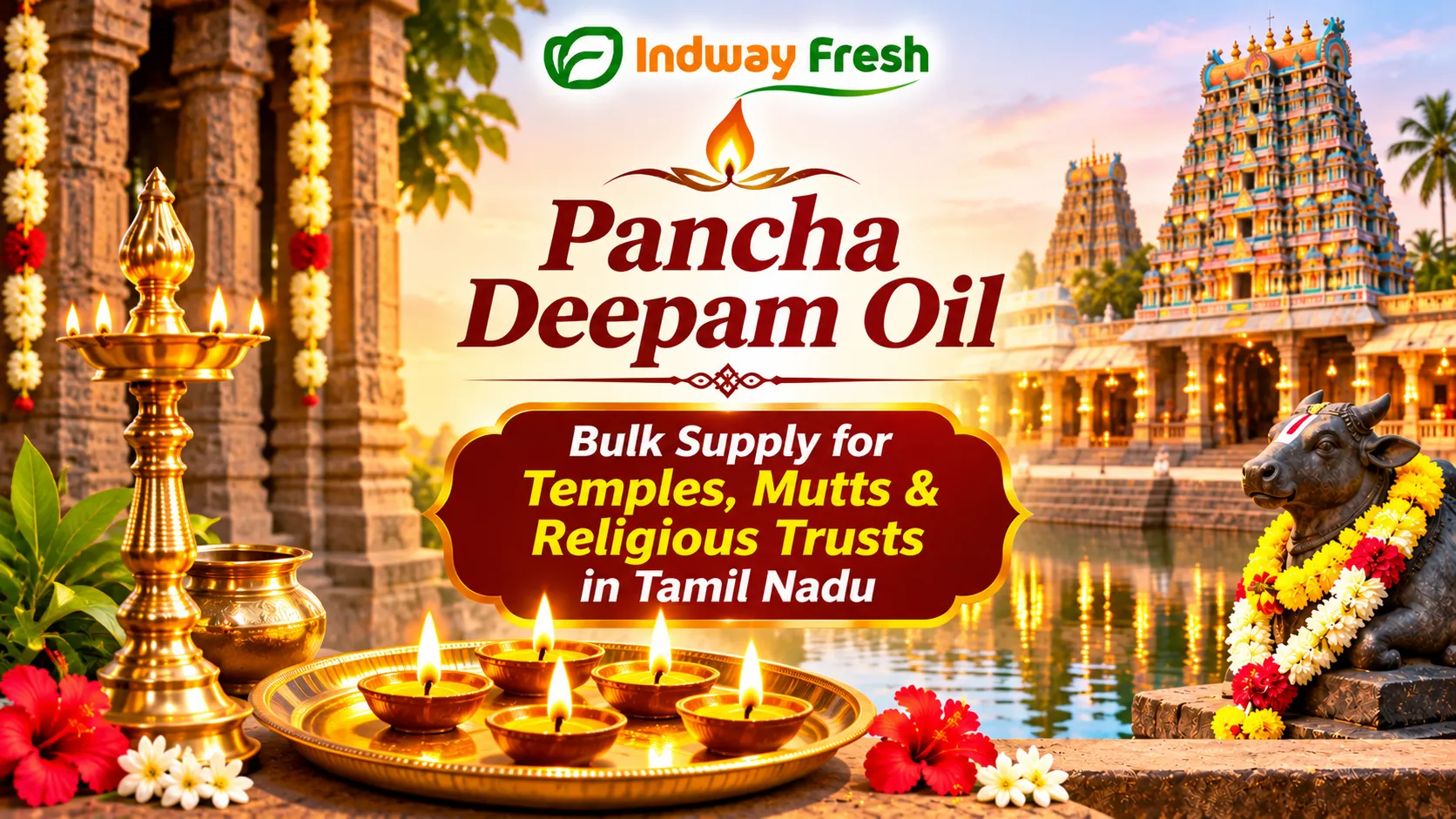
Every evening, thousands of temples, mutts, and trusts across Tamil Nadu light lamps for daily poojas, festivals, and special abhishekams. Pancha Deepam oil, the traditional five-oil blend, is central to this practice. For temple administrators, the challenge is not just finding oil. It is finding a consistent, pure, and reliably supplied oil in the volumes a temple really uses.
This guide covers what to look for in a bulk supplier, how to plan quantities, and how to avoid the common pitfalls.
What Is Pancha Deepam Oil?
Pancha Deepam oil is a blend of five oils used for lighting lamps in temples and homes. Traditionally, the blend is believed to bring prosperity, remove obstacles, and please the deities.
Formulations vary by temple tradition, region, and agama. A commonly used combination includes:
- Gingelly (sesame) oil
- Coconut oil
- Castor (amanakku) oil
- Neem oil
- Iluppai (mahua) oil
Some traditions also include cow ghee. Always confirm the exact blend with your temple’s priests or trust board before ordering. A good supplier will prepare the blend to your specification rather than push a single fixed formula.
Why Temples Need a Dedicated Bulk Supplier
Buying lamp oil from local retail shops works for small households. It breaks down at temple scale:
- Inconsistent quality: Adulterated or mixed-grade oil burns poorly, smokes heavily, and leaves residue on lamps and walls.
- Price swings: Retail prices change often, which makes annual budgeting difficult for trusts.
- Festival-season shortages: Karthigai Deepam, Navaratri, Margazhi, and Aadi festivals multiply demand at the same time everywhere.
- No traceability: Retail purchases rarely come with batch records or documentation, which many trusts need for accounts and audits.
A dedicated bulk supplier solves these with fixed specifications, scheduled deliveries, and proper billing.
Why Cold-Pressed Oils Suit Temple Use
Cold-pressed (Kachi Ghani / Chekku / Kolhu) extraction crushes seeds at low temperatures, without chemical solvents or high-heat refining. For lamp oil this gives you:
- Cleaner, steadier flame: Fewer impurities mean less smoke and soot.
- Natural aroma: The oils retain their characteristic fragrance, which is part of the traditional experience.
- No chemical residue: No solvent extraction, bleaching, or deodorizing.
- Traditional alignment: Wood-pressed oils match the authenticity that devotees and priests expect.
What to Check Before Choosing a Supplier
Use this checklist when evaluating bulk suppliers.
| Criteria | What to Ask |
|---|---|
| Licensing | Valid FSSAI registration (number: [to be added]) |
| Manufacturing | Own extraction unit or a trader? Process used? |
| Blend control | Can they prepare the blend to your temple’s formula? |
| Quality testing | Batch-wise testing, lab reports available on request |
| Packaging | Options such as 15 L tins, 20 L cans, 50 L / 200 L drums |
| Minimum order (MOQ) | Is it practical for your annual consumption? |
| Delivery | Transport to your location, schedule, festival-season priority |
| Billing | GST invoice, credit terms, rate contracts for trusts |
Planning Your Annual Requirement
Estimate demand before approaching suppliers:
- Count daily lamps at the sannidhis, prakarams, and entrance.
- Estimate oil per lamp per day (varies by lamp size).
- Add festival uplift, often a multiple of normal use during peak events.
- Include special events such as Karthigai Deepam, annual brahmotsavam, and lamp-lighting offerings by devotees.
- Add a buffer of 10–15% for unplanned usage.
Then order in scheduled lots rather than a single large purchase. This reduces storage risk, since oil is best used while fresh, and keeps cash flow manageable.
Frequently Asked Questions
1. What is the minimum order for temple bulk supply?
MOQ depends on pack size and blend. Please share your requirement for a specific quote. (MOQ to be confirmed.)
2. Can you prepare our temple’s own five-oil blend?
Yes. Share the ratio or the oils your tradition follows, and the blend can be prepared to that specification.
3. Do you supply outside Madurai?
Bulk supply can be arranged across Tamil Nadu. Delivery terms depend on quantity and location.
4. Can registered trusts get a rate contract?
Yes, annual rate contracts can be arranged for trusts and mutts so budgets stay predictable.
5. Is Pancha Deepam oil safe to use for cooking?
No. It is for lamp lighting only. Edible oils are supplied separately.
6. Do you provide GST invoices and quality documents?
Yes. Invoices and batch-related documents can be provided on request.
