

-
Vinoth
- Posted on
- Categories:General
- 0 comments
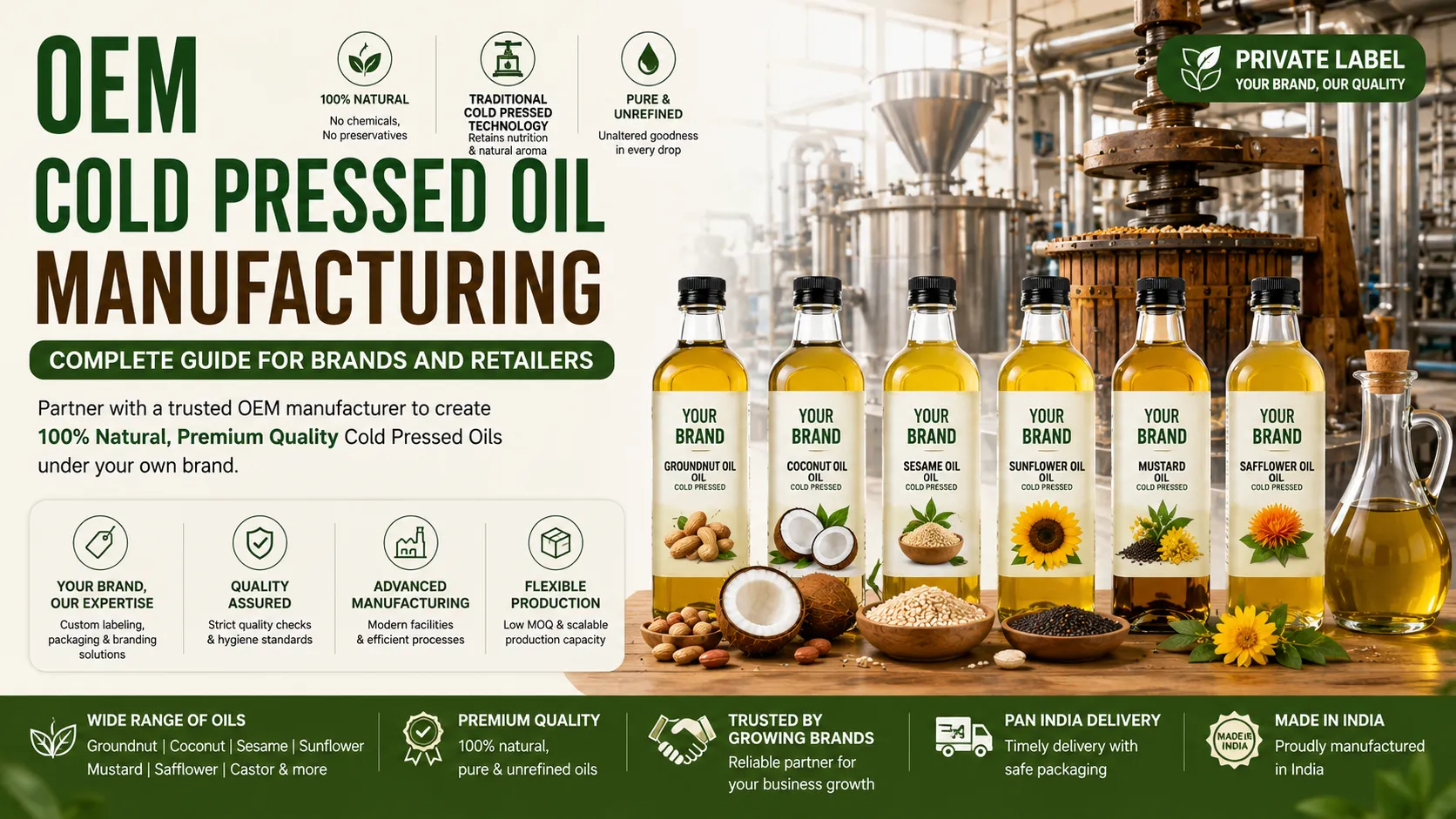
If you are building a D2C brand in the health food, Ayurvedic wellness, or natural skincare space, few decisions are as consequential as choosing your oil supply partner. Consumers today read labels, research sourcing, and demand transparency — and cold-pressed oils sit squarely at the intersection of all three. This guide walks you through everything you need to know about working with an OEM cold pressed oil manufacturer: what to look for, how the process works, and how to turn a quality oil into a winning product.
What Is OEM Cold Pressed Oil Manufacturing?
OEM (Original Equipment Manufacturer) in the context of food and wellness products refers to a manufacturing partner that produces goods under your brand label, using their facility, equipment, and expertise. An OEM cold pressed oil manufacturer takes raw oilseeds or nuts — sesame, coconut, groundnut, flaxseed, castor, and more — and extracts oil using mechanical cold pressing without the application of external heat.
The key distinction from refined oils: cold pressing preserves naturally occurring antioxidants, vitamins, essential fatty acids, and aromatic compounds that heat and chemical processing would destroy. For a D2C brand, this is not just a quality claim — it is your core marketing proposition.
Why D2C Brands Are Turning to OEM Cold Pressed Oil Partners
The shift toward OEM partnerships in the cold pressed oil segment is accelerating, driven by several converging trends.
1. Consumer Demand for Clean Labels. Health-conscious buyers in India, the USA, the EU, and Southeast Asia are actively seeking minimally processed cooking oils and carrier oils. A verified, well-positioned cold-pressed oil with clear sourcing appeals directly to this audience.
2. Lower Capital Investment Setting up your own cold pressing facility requires significant capex — stone crushers or wooden churner (ghani) equipment, controlled environment storage, and food safety infrastructure. Partnering with an OEM allows you to launch with packaging and branding investment alone.
3. Speed to Market An experienced OEM manufacturer already holds FSSAI, AYUSH, GMP, or organic certifications. Instead of spending 12–18 months building compliance, you can launch in weeks.
4. Private-Label Flexibility Whether you want a single SKU or a full range—from black seed oil to cold-pressed coconut oil—a capable OEM partner can scale with your catalog without you managing production complexity.
How Cold Pressing Works: A Quick Primer for Brand Owners
For STANDARDCOLDPRESSEDOILS,
What Is Cold Pressing?
Cold pressing is a mechanical extraction method in which seeds, nuts, or fruits are pressed to release oil—the core principle is to minimize heat during the entire extraction process. Seed oil-free certified
On temperature: the British Association of Cold-Pressed Oil Producers stipulates that, to be considered cold-pressed, the extraction process cannot exceed 40°C / 104°F
Understanding your product builds confidence in your marketing and helps you ask the right questions during supplier due diligence.
Cold pressing is a mechanical extraction process where oilseeds are pressed in an expeller or traditional wooden churner (wooden-kolhu/marachekku) at temperatures typically below 40–45°C. No chemical solvents (like hexane), no bleaching, no deodorizing. The result is a raw, unrefined oil that retains its natural color, aroma, and nutritional profile.
The Step-by-Step Process
Step 1 — Sourcing & Cleaning
High-quality seeds or nuts are sourced, such as sunflower seeds, sesame seeds, or coconuts. These are thoroughly cleaned to remove impurities like dirt, stones, and foreign particles. Seeds are washed and carefully sorted so only premium-quality inputs are used, and then dried to remove moisture, which is crucial for optimal oil extraction. MTC Agri
Step 2 — Mechanical Pressing
The raw material is placed in a press, and physical pressure alone squeezes the oil out. The oil retains its full nutrient profile — vitamins, fatty acids, antioxidants, and natural color and scent.
Step 3 — Temperature Control (The Most Critical Step)
In cold pressing, lower rotation speeds are used to reduce friction and heat generation. While regular expeller pressing can reach temperatures of 140°F, cold pressing keeps temperatures moderated within 100°F throughout the process.
Step 4 — Filtration & Settling
The extracted oil is filtered to remove residues and impurities, then allowed to settle in tanks where gravity helps separate any remaining solid particles — enhancing purity while maintaining the oil’s natural properties.
Step 5 — Bottling
The oil is filled into sterilized glass bottles or food-grade containers in a controlled environment to ensure freshness and prevent contamination.
🆚 Cold-Pressed vs. Refined Oil
| Feature | Cold Pressed | Refined |
|---|---|---|
| Heat | ❌ No | ✅ High heat used |
| Chemicals | ❌ None | ✅ Hexane solvent |
| Nutrients | ✅ Fully retained | ❌ Mostly destroyed |
| Color & Aroma | ✅ Natural | ❌ Bleached & deodorized |
| Shelf Life | 12–18 months | Longer |
| Cost | Higher | Lower |
Cold-pressing is slow, produces less oil, and therefore costs more. But what comes out of the press is essentially the same oil that existed inside the plant — intact and unaltered
If a label doesn’t say “cold-pressed” or “expeller-pressed,” assume it has been solvent-extracted. A quick test: if the oil is crystal clear and completely odorless, it is almost certainly refined.
💡 Key Takeaways for Brand Owners
1. Lead with Transparency
List your extraction method clearly — this is what separates quality brands from those cutting corners, and it is the easiest way for customers to identify the difference.
2. Not All “Cold-Pressed” Labels Are Equal
Two oils labeled “cold-pressed” may still differ in taste, appearance, sourcing, and overall processing—labeling standards and production methods vary by manufacturer and country. Seed oil-free certified
3. Educate on Shelf Life
Cold-pressed oils have a shorter shelf life of typically 12–18 months because the natural compounds that make them nutritious are also susceptible to oxidation. Always advise customers to store in a cool, dark place with the cap sealed.
4. Market Opportunity is Huge
The cold pressed oil market is estimated to reach $36.5 billion, with a 5.3% growth predicted between 2019 and 2026 — and cold pressed oils command the highest price point compared to solvent-extracted or hot-pressed alternatives.
5. Chemical-Free = Environmental Advantage
Cold pressed oils can be produced without additional chemicals — unlike hot extraction which requires sodium hydroxide, bleaching agents, and others. Fewer chemicals in the process means fewer chemicals entering waste systems and the environment
Common cold pressed oils and their end-use segments:
A good OEM cold pressed oil manufacturer will offer multiple oils under a unified quality system, making it easy to build a product family.
1. Certifications and Compliance
At minimum, your manufacturing partner should hold:
- FSSAI License (mandatory for India-based supply)
- GMP Certification — Good Manufacturing Practices ensure consistent quality
- AYUSH Certification — Essential if positioning oils in Ayurvedic or traditional medicine categories
- Organic Certification (NPOP / NOP / EU Organic) — Critical for premium and export markets
- ISO 22000 or HACCP — For export-ready food safety standards
2. Seed-to-Bottle Traceability
The best OEM partners have direct relationships with farmers or established procurement chains. This enables:
- Origin documentation (region, farm, variety)
- Pesticide residue testing at raw material stage
- Seed quality grading before pressing
This traceability is what allows you to tell a genuine brand story — and support it with documentation.
3. Pressing Method Transparency
Clarify which pressing method is used:
- Wooden churner / marachekku / ghani pressing—Traditional, slower, maintains very low temperatures; commands premium positioning
- Mechanical expeller pressing — Faster, scalable, but must be monitored to stay in “cold pressed” temperature range
Some manufacturers use both, depending on the oil type. Make sure what is on your label reflects what happens in the facility.
4. Quality Testing Infrastructure
A reliable OEM cold pressed oil manufacturer will have in-house or empanelled lab testing covering:
- Acid value, peroxide value, and FFA (Free Fatty Acid) — freshness indicators
- Moisture content
- Heavy metals panel
- Pesticide residue (especially for export)
- Organoleptic parameters (color, odor, taste)
Request a sample Certificate of Analysis (CoA) for any oil you plan to private-label.
5. Packaging Capabilities
Cold pressed oils require packaging that protects from light oxidation. Check for:
- Dark glass bottle filling (amber or green glass)
- HDPE food-grade plastic options for mass-market SKUs
- Tin/metal container capability for bulk B2B
- Custom label printing or third-party label application support
- Tamper-evident sealing
If you are exporting, ensure packaging meets destination market labeling requirements (EU regulation 1169/2011, FDA CFR 21, etc.).
6. MOQ and Scalability
Understand minimum order quantities at both the bulk (kgs/liters) and finished SKU (units) level. A good OEM partner for D2C brands will offer:
- Small-batch pilot runs (50–100 units) for product validation
- Scalable production batches as your brand grows
- Flexible reorder lead times (typically 7–21 days for standard oils)
The OEM Cold-Pressed Oil Process: From Brief to Shelf
Here is a typical workflow when you engage an OEM cold-pressed oil manufacturer as a D2C brand:
Step 1 — Product Brief Define the oil type, positioning, target market, and any specific claims (organic, wood-pressed, single-origin). Share your desired packaging format and label requirements.
Step 2 — Sample Development Request samples across 2–3 production batches to assess consistency. Evaluate color, aroma, viscosity, and taste if applicable. Review the CoA.
Step 3 — Commercial Agreement Finalize MOQ, pricing, lead time, payment terms, and IP ownership of formulations and label designs. Ensure a non-disclosure clause if you have a proprietary blend.
Step 4 — Artwork and Label Approval Share print-ready artwork. Confirm label compliance for your target market (FSSAI for India, EFSA/EU for Europe, FDA for USA).
Step 5 — First Production Run The manufacturer produces, fills, labels, and packs to your spec. Request pre-shipment QC documentation.
Step 6 — Fulfillment and Ongoing Reorders Align on reorder triggers, shelf-life management (most cold pressed oils carry 12–24 months with proper packaging), and storage guidance.
Private-Label Cold-Pressed Oils for Export Markets
If you are building a brand for the USA, EU, Middle East, or Southeast Asia, OEM cold-pressed oil manufacturing becomes even more strategic. Export-oriented manufacturers will assist with:
- Certificate of Origin (COO) for customs
- Phytosanitary certificates were required
- MSDS / Safety Data Sheets for cosmetic-grade oils
- Halal / Kosher certification for the Middle Eastern and certain Asian markets
- Organic equivalency documentation for EU and USDA NOP
India-based OEM manufacturers — particularly those in Tamil Nadu, which has a centuries-old tradition of sesame, groundnut, and coconut oil pressing — are increasingly export-ready and price-competitive compared to EU or US-based processors.
Building a Brand Around Cold-Pressed Oils: Marketing Considerations
The oil is only the start. Here is how successful D2C brands differentiate:
- Origin storytelling: Single-district, heritage variety sourcing (e.g., Gingelly from Virudhunagar, Coconut from Pollachi) creates authenticity that no commodity brand can replicate.
- Process transparency: Video content showing the wooden churner or cold pressing equipment resonates strongly with health-conscious consumers.
- Third-party lab reports: Publishing COA results on your product page builds trust and reduces purchase hesitation.
- Certifications on packaging: Organic, FSSAI, and AYUSH logos are visual trust signals, especially for first-time buyers.
- Subscription models: Cold-pressed oils are repeat-purchase products; a subscription model dramatically improves LTV.
Conclusion: Choose Your OEM Partner Before You Choose Your Packaging
D2C brand builders often spend months on branding and websites before they have a reliable supply chain. In cold-pressed oils, that is a mistake. Your OEM cold-pressed oil manufacturer is your quality foundation — and your brand story is only as strong as what is actually inside the bottle.
Prioritise manufacturers with verified certifications, documented traceability, transparent pressing practices, and the flexibility to grow with your brand. The right OEM partner is not just a supplier; they are the backbone of every claim you make to your customer.
If you are sourcing cold-pressed oils for private-label or bulk export, connect with a manufacturer who understands both traditional pressing heritage and modern food safety standards.
