

-
Vinoth
- Posted on
- Categories:General
- 0 comments
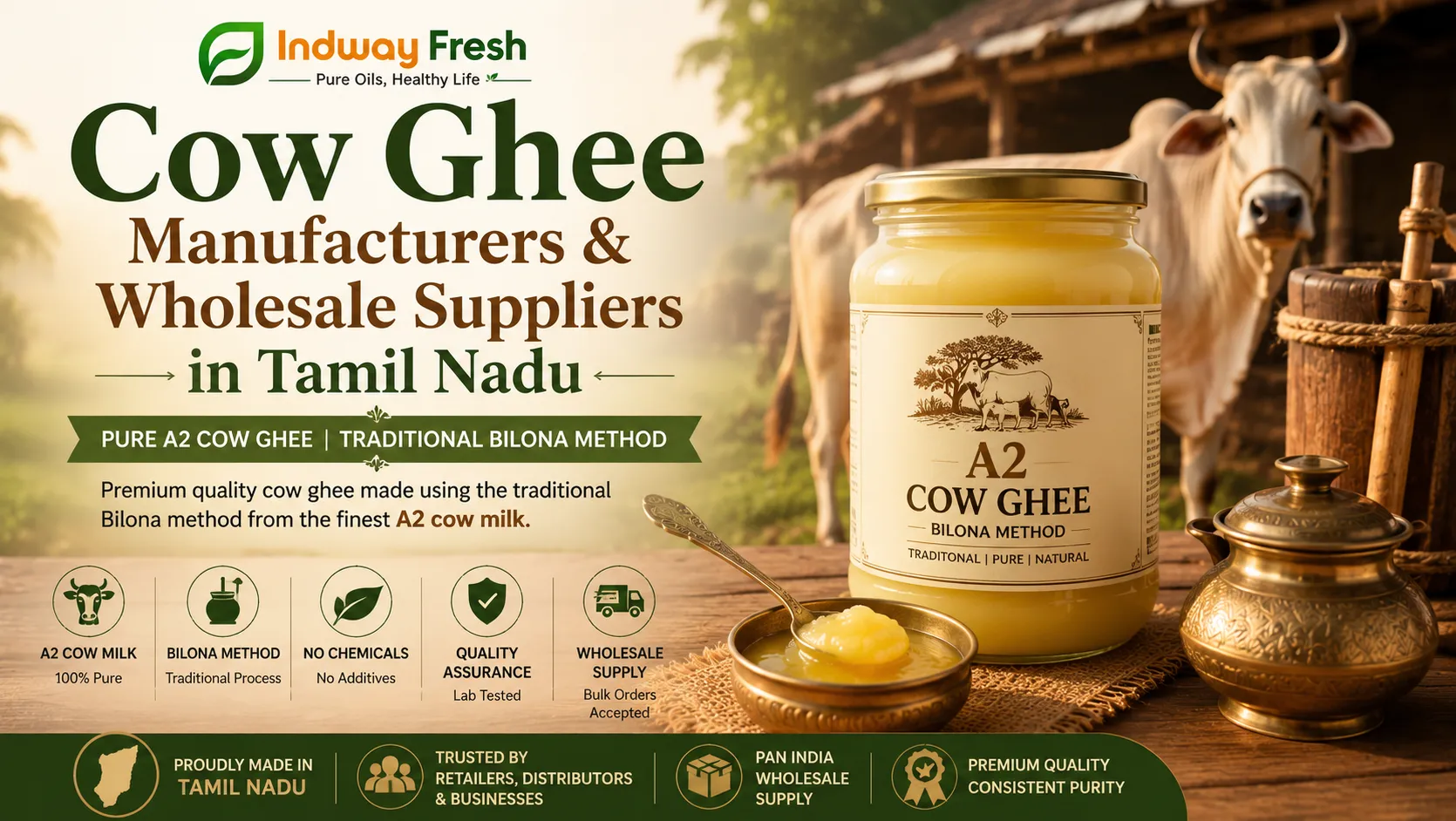
Ghee adulteration is one of the most persistent food safety problems in India. It’s not a fringe issue — published food safety surveys and FSSAI enforcement data estimate that 30-40% of ghee products in the Indian market carry some degree of adulteration. Law enforcement has repeatedly seized large quantities of fake ghee made from vanaspati and cheap refined oil, particularly around festive seasons. For wholesale buyers — retailers, HoReCa operators, gifting businesses, and D2C brands — sourcing ghee from a manufacturer who can back purity claims with real test data isn’t optional caution, it’s basic due diligence.
This guide covers how ghee purity is actually tested in India, what wholesale buyers should ask a Tamil Nadu-based manufacturer or supplier, and what affects bulk pricing.
Why Ghee Adulteration Is So Common
Adulteration typically starts because the market price of raw oils and fats runs at roughly a third of the market price of ghee, while genuine ghee supply doesn’t keep pace with demand — a gap that creates strong financial incentive for adulteration, and it can begin as early as the milk stage. The most common adulterants are vanaspati (hydrogenated vegetable fat), cheap refined vegetable oils, animal body fats, and in cruder cases, starch.
How FSSAI Tests for Ghee Purity
The Core Compositional Standard
FSSAI standards require ghee to contain a minimum of 99.6% milk fat, with adulteration using non-milk fats, synthetic colours, or additives strictly prohibited.
Baudouin Test
The Baudouin test is the standard method for detecting vanaspati, hydrogenated fat, refined vegetable oil, and animal fats in ghee — a positive result is a clear sign of adulteration and fails the ghee purity test outright.
Furfural Test
Where the Baudouin test catches vanaspati and hydrogenated fats, the Furfural test specifically detects adulteration of ghee with sesame oil.
RM Value & Polenske Value
A minimum Reichert-Meissl (RM) value of 24 is now required uniformly across India under the latest FSSAI notification — a lower RM value can point to the presence of non-dairy fats, and this test is particularly useful for detecting adulteration with palm olein and animal body fats. The Polenske value measures insoluble volatile fatty acids in ghee, with a standard range of 1.0 to 2.0 for ghee from non-cotton-tract regions.
Beta-Sitosterol / Phytosterol Test
FSSAI approved a newer detection method based on identifying cholesterol and beta-sitosterol markers in the unsaponifiable matter of ghee samples — the presence of beta-sitosterol specifically indicates vegetable fats have been added, since it has no place in genuine milk fat.
AGMARK Grading
The AGMARK certification system, administered under the Government of India, classifies ghee into three grades based on free fatty acid content: Special (max 1.4% FFA), General (max 2.5% FFA), and Standard (max 3.0% FFA) — and for any grade, the Baudouin test, phytosterol test, and non-milk animal fat tests all have to come back negative.
What This Means for a Wholesale Buyer
You don’t need to run these tests yourself — but you should know what to ask for. A supplier who takes purity seriously will readily share:
- A current lab report covering RM value, Baudouin test result, and beta-sitosterol status.
- FSSAI licence details, verifiable independently rather than taken from packaging alone.
- AGMARK certification, if claimed — and which grade specifically.
- Sourcing method — whether the ghee is bilona (traditional curd-churned), creamery-processed, or a blend, since this affects both price and product character.
- Batch traceability, so any quality concern can be traced back to a specific production run.
As a rough price sanity check, genuine cow ghee is difficult to produce profitably below roughly ₹500/kg, and authentic bilona-method ghee below roughly ₹700/kg — if a wholesale quote comes in well under these thresholds, adulteration risk should be treated as high, though high price alone doesn’t guarantee purity either.
Bilona vs. Creamery Ghee: What’s the Difference
- Bilona ghee follows the traditional method: milk is set to curd, hand-churned to separate butter, and the butter is then slow-cooked into ghee. This process is slower and lower-yield, which is reflected in higher pricing, but it’s associated with better aroma, texture, and nutrient retention.
- Creamery/direct-cream ghee is made by separating cream directly from milk (bypassing the curd-and-churn step) and processing it into ghee at larger scale—more efficient for volume production, generally priced lower.
Neither method is inherently “fake”—both can be genuine, pure ghee. The distinction matters for positioning and pricing, not purity, so buyers should confirm which method a supplier uses rather than assuming.
Why Tamil Nadu Is a Strong Sourcing Base
Tamil Nadu has a well-established dairy and food manufacturing ecosystem, with manufacturers in the region increasingly producing ghee alongside their existing cold-pressed oil and natural food product lines — giving wholesale buyers access to a single regional supplier for multiple natural food categories rather than managing separate vendor relationships.
Questions to Ask Before a Bulk Ghee Order
- Can you share your most recent lab test report, including RM value and Baudouin test result?
- Is this bilona-method or creamery ghee?
- Do you hold FSSAI licensing and, ideally, AGMARK certification?
- What’s your MOQ and standard delivery cycle for bulk orders?
- What packaging formats are available for wholesale (tins, jars, bulk containers)?
- How do you handle a batch that fails a quality check on your end?
Sourcing from Indway Fresh
Indway Fresh is a Madurai, Tamil Nadu-based manufacturer and wholesale supplier of natural food products, including cow ghee, alongside its cold-pressed oil, honey, and other natural product lines. The company is GMO (Food Safety Management System with HACCP) certified and offers wholesale pricing, private-label options, and custom bulk solutions for retailers, distributors, and businesses.
Sourcing cow ghee in bulk from Tamil Nadu?
Get in touch with Indway Fresh for wholesale and bulk enquiries — Madurai, Tamil Nadu. Submit an enquiry through the Indway Fresh wholesale enquiry form.
Frequently Asked Questions
What’s the most reliable way to check if ghee is adulterated?
A lab report covering the Baudouin test (for vanaspati and hydrogenated fats), RM value (minimum 24 under current FSSAI standards), and beta-sitosterol status is the most reliable check — home tests can catch crude adulteration but aren’t a substitute for lab verification.
Is AGMARK-certified ghee guaranteed to be pure?
AGMARK certification requires the Baudouin test, phytosterol test, and non-milk fat tests to all be negative, which gives strong assurance, but buyers should still ask for current batch-level test reports rather than relying on certification alone.
Why is bilona ghee more expensive than regular ghee?
Bilona ghee follows the traditional curd-churning method, which is slower and lower-yield than direct cream separation, driving up production cost — but it isn’t the only method that produces genuine, pure ghee.
How much ghee adulteration actually happens in the Indian market?
Estimates from published food safety surveys and FSSAI enforcement data put adulteration at 30-40% of market products overall, with the rate significantly higher in the unbranded/loose market compared to AGMARK-certified branded products.
