

-
Vinoth
- Posted on
- Categories:General
- 0 comments
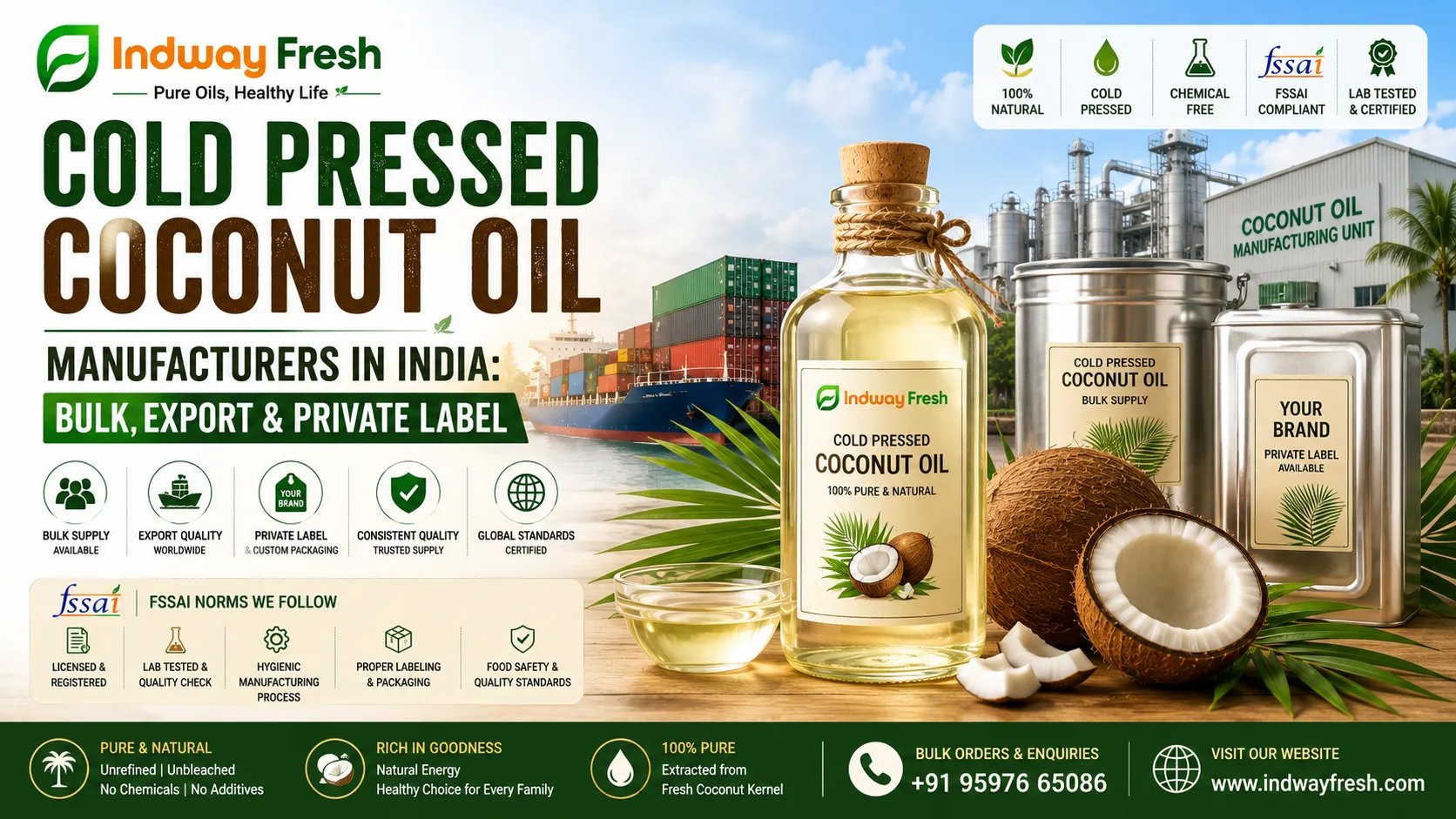
Coconut oil sits in a slightly different category from other cold-pressed oils exported out of India — it’s more shelf-stable, has a stronger global health-and-wellness positioning outside the diaspora market, and India’s raw material base (among the world’s largest coconut producers) gives manufacturers genuine scale advantages. That combination is why coconut oil manufacturers based in India serve three very different buyer types from the same production line: bulk domestic buyers, international export clients, and private-label brands.
This guide breaks down what each buyer type needs to know when evaluating a cold-pressed coconut oil manufacturer.
How Cold-Pressed Coconut Oil Is Actually Made
Cold-pressed coconut oil is extracted from fresh or dried coconut kernel using mechanical pressing — a wooden or rotary Chekku/Kolhu press in the traditional method — without applying external heat or chemical solvents during extraction. This is different from copra oil (made from dried, sometimes smoked coconut) and refined coconut oil (which is deodorized and bleached), both of which lose the natural aroma and some nutrient content that cold-pressing preserves. A manufacturer’s ability to clearly explain which method they use, and back it with process details rather than marketing language, is one of the simplest ways to separate a genuine cold-press operation from one blending in refined stock.
Quality Parameters That Matter for Coconut Oil Specifically
- Free Fatty Acid (FFA) value—indicates freshness and processing quality; lower is generally better for cold-pressed oil.
- Moisture content— affects shelf life and rancidity risk.
- Peroxide value—an oxidation indicator, especially relevant for oil that will sit in transit or storage for export orders.
- Lauric acid content—coconut oil’s signature fatty acid, often referenced by health-focused buyers as a quality marker.
- Color and aroma consistency—a practical, low-cost check most buyers can do themselves batch to batch, and a useful early warning sign if something’s changed on the manufacturer’s end.
Ask any manufacturer for a Certificate of Analysis covering these parameters per batch, not just a one-time product spec sheet.
Buyer Type 1: Bulk Domestic Buyers
Retailers, HoReCa operators, and wholesalers sourcing coconut oil in bulk within India should prioritize:
- Consistent supply and delivery cycles—coconut oil demand doesn’t fluctuate as seasonally as some other categories, but manufacturing capacity and raw coconut availability can still create supply gaps.
- Packaging suited to volume—tins and drums rather than retail bottles, to keep per-litre cost down at scale.
- FSSAI and gmo/HACCP certification, verified independently rather than taken at face value.
Buyer Type 2: Export Buyers
International buyers—whether in the Gulf, Southeast Asia, Australia, Europe, or North America—are generally looking for:
- FSSAI export documentation and IEC (Import Export Code) on the manufacturer’s side as the baseline.
- APEDA registration, since coconut oil falls under agricultural and processed food export categories where APEDA is the relevant export promotion body.
- Batch-level Certificate of Analysis and lab test reports, which most destination countries’ importers need to satisfy their own compliance requirements (FSVP in the USA, SFC licensing documentation in Canada, EU contaminant and composition standards, and so on).
- Export packaging formats — tins, drums, or flexitanks depending on order volume and destination market norms.
Export-ready manufacturers should be able to speak specifically to which markets they’ve shipped to and what documentation they routinely prepare — vague answers here are a signal to dig deeper before committing.
Buyer Type 3: Private-Label Brands
D2C and retail brands building their own coconut oil line without owning manufacturing infrastructure need a manufacturer who explicitly supports:
- Custom labelling and packaging — not every bulk manufacturer offers this; confirm it rather than assume.
- Reasonable MOQ for new or growing brands — a first-time private-label client typically doesn’t need container-scale minimums.
- Consistent batch-to-batch quality, since a private-label brand’s reputation rides entirely on a manufacturer they don’t control day-to-day.
- Willingness to share documentation the brand will need for its own FSSAI registration and marketplace listings.
Questions Every Buyer Type Should Ask
- Is this genuinely cold-pressed, and how is that verified — not just claimed?
- Can you provide a batch-level Certificate of Analysis?
- What’s your FSSAI licence status, and can I verify it independently?
- What packaging and MOQ options do you offer for my order type (bulk, export, or private label)?
- For export specifically: which markets have you shipped to, and what documentation do you routinely prepare?
- For private label specifically: what’s your turnaround time on custom packaging?
Sourcing from Indway Fresh
Indway Fresh is a Madurai, Tamil Nadu-based manufacturer of cold-pressed coconut oil, produced using traditional cold-press extraction without chemical solvents or added heat. The company is gmo (Food Safety Management System with HACCP) certified, and supports bulk wholesale orders, private-label packaging, and custom bulk solutions for retailers, distributors, and new brands.
[Placeholder — verify before publishing: Indway Fresh’s specific FSSAI licence number, current export market experience, APEDA/RCMC registration status, MOQ across bulk/export/private-label order types, and pricing are not publicly listed in detail and should be confirmed directly with the team before this section goes live with specifics.]
Sourcing cold-pressed coconut oil in bulk, for export, or as a private-label partner? Get in touch with Indway Fresh — Madurai, Tamil Nadu. Submit an enquiry through the Indway Fresh wholesale enquiry form.
Frequently Asked Questions
What’s the difference between cold-pressed and refined coconut oil?
Cold-pressed oil is extracted mechanically without heat or chemical solvents, preserving natural aroma and nutrients. Refined coconut oil undergoes additional processing — often including deodorizing and bleaching — which strips much of that natural character in exchange for a longer shelf life and neutral flavour.
Do I need different documentation for bulk domestic orders versus export orders?
Yes. Domestic bulk buyers mainly need FSSAI verification and consistent supply. Export buyers need additional documentation — IEC, APEDA registration, and destination-specific paperwork like Certificates of Origin, lab reports, and compliance documents relevant to the importing country.
Can a private-label brand order small quantities from a coconut oil manufacturer?
It depends on the manufacturer—not all bulk producers support private label or low-MOQ orders. Confirm this explicitly before assuming a manufacturer set up for large-scale export or wholesale will also accommodate a smaller first order.
How can I verify a manufacturer’s cold-press claim?
Ask specifically how the oil is extracted (traditional Chekku/Kolhu press vs. expeller vs. refined process), request a Certificate of Analysis, and where possible, verify through a facility visit or third-party audit rather than relying on packaging language alone.
