

-
Vinoth
- Posted on
- Categories:General
- 0 comments
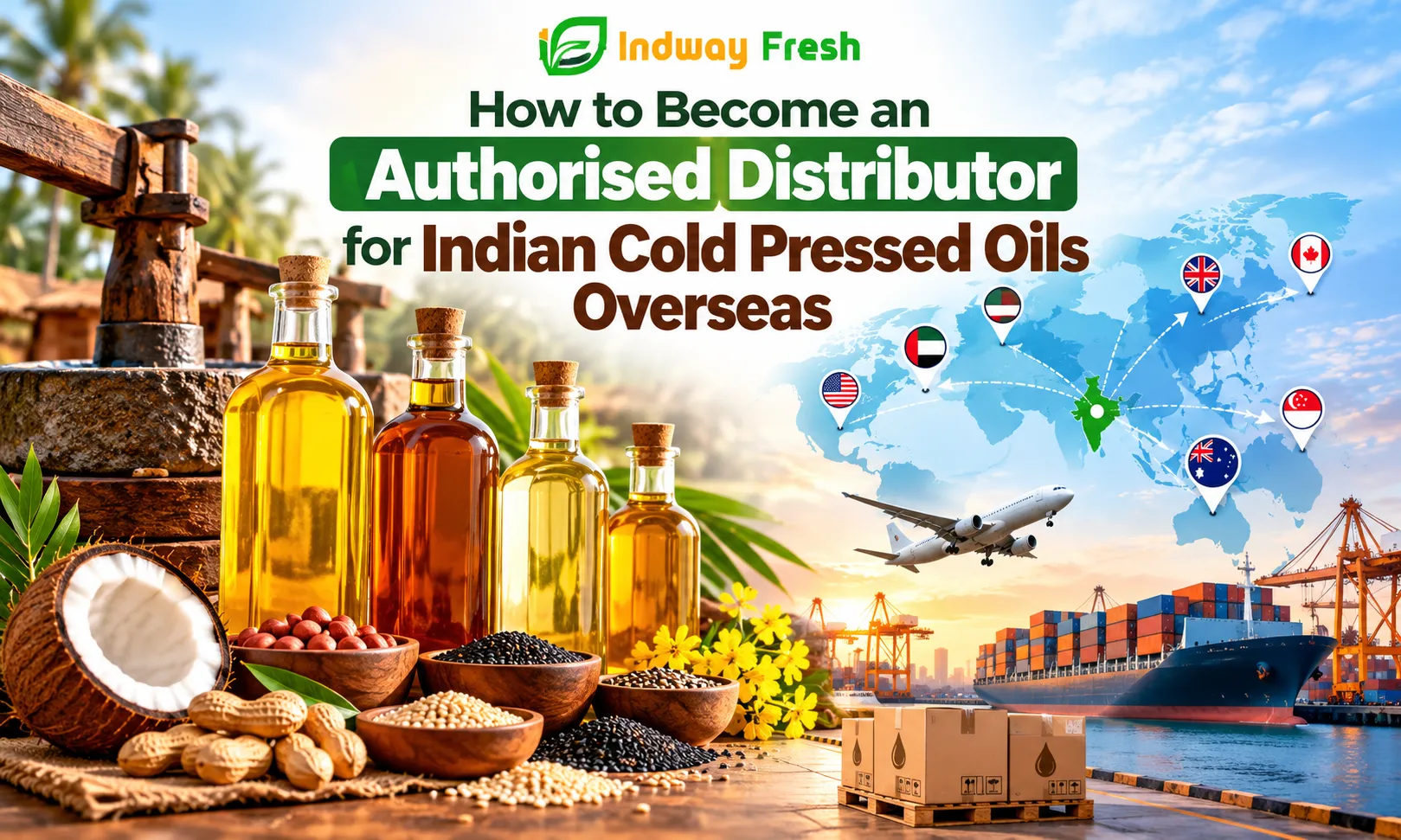
Demand for wood-pressed and cold-pressed oils is growing fast among health-conscious buyers in the UAE, UK, USA, Canada, Australia, Singapore, and Malaysia. Indian Kachi Ghani / Chekku / Kolhu oils (groundnut, sesame, coconut, and mustard) are especially popular with diaspora and wellness-focused customers. If you want to import and sell them in your country, becoming an authorized distributor of an Indian manufacturer is the safest route. It gives you supply security, brand credibility, and often territory protection.
This guide walks through the process step by step.
1. Understand What “Authorised Distributor” Means
An authorized distributor is a business formally appointed by a manufacturer or brand owner to import, market, and sell its products in a defined territory (a country, region, or channel).
| Model | Who holds the brand rights? | Best for |
|---|---|---|
| Authorised distributor (own brand of manufacturer) | Manufacturer | Importers with strong local retail or HoReCa networks |
| Exclusive distributor | Manufacturer, with territory exclusivity | Serious players who can commit to volume targets |
| Private label / white label | You | Businesses that want to build their own brand |
| Sub-distributor | Master distributor | Regional or city-level expansion |
Decide first whether you want to sell an existing Indian brand or build your own private label. The approach and paperwork differ.
2. Check Your Own Import Requirements First
Before contacting suppliers, confirm the rules in your country:
- Business registration (company, import license, or importer code where required)
- Food safety registration with your local authority (for example, FDA registration in the USA, food business registration in the UK/EU, or municipality approval in the UAE)
- Labelling rules: language, ingredient declarations, nutrition panel, shelf life, importer address
- Import duty and tax: check the HS code for each oil (e.g., groundnut, sesame, coconut, and mustard oils fall under different HS codes)
- Cold storage and warehousing: not always mandatory, but needed for quality retention
Rules change often, so verify with your local customs broker or food authority before placing an order.
3. Find Genuine Indian Cold-Pressed Oil Manufacturers
Look for manufacturers who have real production capacity and export experience, not just traders. Good places to search:
- APEDA and export promotion council directories
- B2B trade platforms (use them for discovery, then verify independently)
- Food and agri-trade fairs such as Gulfood, Anuga, SIAL, and BioFach
- Direct brand websites of cold-press manufacturers in Tamil Nadu, Gujarat, Maharashtra, and Karnataka
- Referrals from other importers or trade consultants
4. Verify the Manufacturer Before You Commit
This step protects you from quality and payment risk. Ask for and check:
- FSSAI licence (manufacturing and export)
- IEC (Import Export Code)
- APEDA registration / RCMC, if applicable
- Quality certifications: HACCP, ISO 22000, GMP, and organic certification if claimed
- NABL-accredited lab reports for parameters such as free fatty acid, peroxide value and moisture
- Extraction method proof: photos or a facility visit showing genuine Kachi Ghani / Chekku / Kolhu extraction, not refined oil relabelled
- Export history and references from existing overseas buyers
- Shelf life and packaging specs suitable for long sea transit
If possible, visit the facility or arrange a third-party audit.
5. Request Samples and Run Quality Checks
Ask for samples of each oil you plan to import. Test them for:
- Aroma, colour and taste consistency
- Lab parameters against your country’s food standards
- Packaging integrity (leakage, seal, label print quality)
- Batch-to-batch consistency (ask for samples from two or more batches)
6. Negotiate the Distribution Agreement
A written agreement is what makes you “authorised”. Key clauses to negotiate:
- Territory: countries or regions covered
- Exclusivity: exclusive vs non-exclusive, and for how long
- Minimum order quantity (MOQ) and annual volume commitments
- Pricing structure: price per unit, FOB or CIF terms, price revision rules
- Payment terms: advance, letter of credit, or staged payments
- Branding and marketing rights: use of logos, images, claims and certifications
- Labelling and compliance responsibility: who handles destination-country labels
- Quality claims and returns: what happens if a batch fails testing
- Term and termination: duration, renewal, exit conditions
- Dispute resolution: governing law and arbitration location
Have a lawyer familiar with international trade review the contract before signing.
7. Understand the Cost Structure
Build a landed-cost sheet before quoting to your own customers.
| Cost component | Notes |
|---|---|
| Ex-factory / FOB price | [Get quote from manufacturer] |
| Ocean or air freight | [Get quote from freight forwarder] |
| Marine insurance | [Confirm with insurer] |
| Import duty and taxes | [Verify with customs broker for your HS code] |
| Destination port, clearance and inland transport | [Local quote] |
| Testing and certification costs | [Confirm] |
| Warehousing and last-mile delivery | [Local quote] |
| Your margin | [Set after channel research] |
Never price your retail range until every line above is confirmed with real quotes.
8. Plan Logistics and Shipping
Pack format: glass bottles, PET bottles, tins or bulk drums. Bulk is cheaper but needs local filling and labelling.
Container type: LCL for trial shipments, FCL for regular volume.
Handling: keep oils away from heat and direct sunlight during transit and storage.
Documentation: commercial invoice, packing list, bill of lading, certificate of origin, quality or lab certificate, and any phytosanitary or health certificate your country requires.
Start with a small trial order to test the whole chain before scaling.
9. Build Your Sales Channels
Once stock is in hand, sell through the channels that fit your market:
- Indian and Asian grocery stores
- Online marketplaces and your own D2C store
- Health-food and organic retailers
- Restaurants, cloud kitchens and catering (HoReCa)
- Ayurveda and wellness centres
- Corporate gifting and festive hampers
Ask your manufacturer for marketing support: product photos, brochures, certification copies and brand story content.
10. Maintain the Relationship and Compliance
- Review sales against agreed targets every quarter
- Keep batch and lab records for traceability
- Track shelf-life and stock rotation (FIFO)
- Stay updated on labelling and import rule changes
- Give the manufacturer regular market feedback so products and packaging improve
Common Mistakes to Avoid
- Working with traders who cannot show a real extraction unit
- Skipping lab tests on the first shipment
- Ignoring destination-country labelling rules
- Signing exclusivity without a minimum performance clause on both sides
- Underestimating freight and duty in your pricing
- Placing a large first order before a trial shipment
Frequently Asked Questions
Do I need an exclusive agreement to be an authorised distributor?
No. Many distributors start non-exclusive and move to exclusivity after proving sales volume.
What is the typical minimum order for export?
It varies by manufacturer and pack type. Ask each supplier for their export MOQ. [Placeholder: confirm with manufacturer]
Can I sell under my own brand instead?
Yes. Many Indian manufacturers offer private labelling for overseas buyers. Confirm label design rights, MOQ and packaging options up front.
How can I confirm the oil is truly cold pressed?
Ask for extraction process details, visit the unit if possible, review lab reports, and check that the price and aroma are consistent with genuine wood-pressed oil.
Which certifications matter most?
FSSAI, HACCP or ISO 22000, and NABL lab reports for Indian compliance, plus whatever your destination country requires.
How long does the whole process take?
Usually several weeks to a few months from first enquiry to first shipment, depending on sampling, agreement negotiation and local compliance. [Placeholder: adjust per brand]
Conclusion
Becoming an authorised distributor for Indian cold-pressed oils overseas comes down to three things: choosing a verified manufacturer, structuring a clear written agreement, and getting your compliance and landed costs right before you scale. Start small, test quality, and grow with a partner who supports your market.
Interested in Distributing Our Cold-Pressed Oils in Your Country?
Interested in distributing our cold-pressed oils in your country?
