

-
Vinoth
- Posted on
- Categories:General
- 0 comments
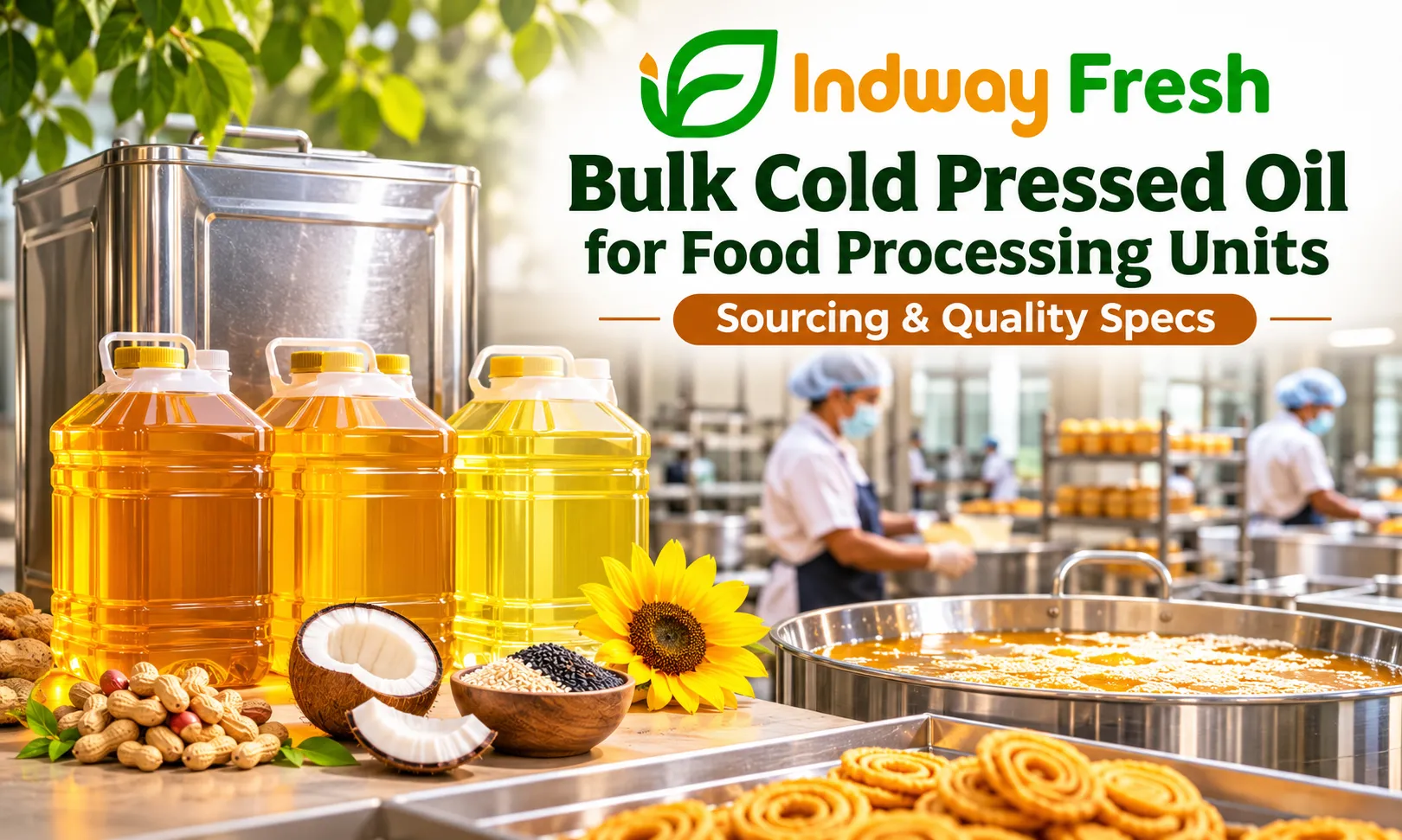
Food processing units that make snacks, pickles, ready-to-cook mixes, bakery items, or traditional sweets are moving towards cold-pressed oils. Buyers want clean-label ingredients, and regional consumers trust the Kachi Ghani / Chekku / Kolhu taste. Switching from refined oil to cold-pressed oil is not a simple swap, though. You are buying a less processed ingredient, so supplier selection and written specifications matter far more.
This guide covers how to source bulk cold-pressed oil and which quality parameters to put in your purchase specification.
Why Food Processors Choose Cold-Pressed Oil
- Clean-label positioning: no chemical solvents (hexane), no bleaching, no deodorizing.
- Authentic flavor and aroma: important for traditional snacks, pickles, sweets, and regional foods.
- Retained natural compounds: tocopherols, phytosterols, and natural pigments stay in the oil.
- Premium pricing: cold-pressed claims can support a higher shelf price in D2C and modern trade.
The trade-off: cold-pressed oil has a stronger flavor, a shorter shelf life than refined oil, and more batch-to-batch variation unless your supplier tightly controls the process.
Oils Commonly Sourced in Bulk
| Oil | Typical Use in Food Processing |
|---|---|
| Groundnut (peanut) oil | Snacks, mixtures, frying (moderate heat), pickles |
| Sesame (gingelly) oil | Pickles, podi/spice mixes, traditional sweets, ready mixes |
| Coconut oil | Chips, sweets, South Indian ready-to-cook products |
| Mustard oil (Kachi Ghani) | Pickles, North/East Indian cuisine products |
| Sunflower/safflower (cold-pressed) | Health-positioned snacks and bakery |
Match the oil to your process temperature. Many cold-pressed oils have lower smoke points than refined oils, so check this before using one in deep-frying lines.
Quality Specifications to Put in Your Purchase Agreement
Do not buy on “100% pure cold-pressed” claims alone. Define these in a written spec sheet.
| Parameter | Why It Matters | Indicative Target |
|---|---|---|
| Free fatty acid (FFA) / acid value | Indicates oil freshness and seed quality | Set per oil type, within FSSAI limits |
| Peroxide value (PV) | Measures primary oxidation/rancidity risk | Low; define a maximum at dispatch. |
| Moisture & volatile matter | Affects shelf life and sediment | Typically ≤ 0.2–0.3% |
| Insoluble impurities | Indicates filtration quality | Define a maximum. |
| Color, odor, taste | Basic sensory consistency | Characteristic of the oil: no off-notes |
| Adulteration checks | Argemone (mustard), foreign oils | Must be absent |
| Aflatoxin (groundnut) | Food safety | Within FSSAI/regulatory limits |
| Heavy metals & pesticide residues | Safety for export and premium buyers | Per FSSAI / destination-market limits |
Documents to Ask Every Supplier For
- FSSAI license (manufacturing, valid, and category-appropriate)
- Certificate of Analysis (COA) for every batch, ideally from an NABL-accredited lab
- HACCP/GMP/ISO 22000 certification, if your buyers require it
- Seed sourcing details: origin, variety, and storage practices
- Traceability records: batch number linked to seed lot and pressing date
- Packaging material declaration: food-grade drums, IBCs, or tankers
Sourcing Checklist: Evaluating a Bulk Supplier
- Process control: Is the oil actually cold-pressed (wooden/stone/rotary Ghani under controlled temperature), or only labelled as such? Ask about the temperature range during extraction.
- Seed quality management: Do they clean, grade, and moisture-check seeds before pressing?
- Filtration and settling: Poor settling leads to sediment and faster rancidity.
- Capacity and consistency: Can they supply your monthly volume without switching seed lots mid-month?
- Lab access: In-house testing for FFA and PV, plus third-party testing for contaminants.
- Sample-to-bulk consistency: Test the production batch against the approved sample, not only the sample.
- Factory audit: Visit in person or run a virtual audit before committing to large volumes.
Packaging, MOQ, and Logistics
| Format | Best For | Notes |
|---|---|---|
| Food-grade HDPE / MS drums (e.g., 200 L) | Mid-size processing units | Check liner and sealing condition. |
| IBC totes (e.g., 1000 L) | High-volume units | Needs handling equipment on-site |
| Tanker supply | Large manufacturers | Requires storage tanks and cleaning protocols |
| Retail-ready bulk cans/jars | Smaller units, trial orders | Higher cost per liter |
Storage and Shelf Life at Your Plant
- Store in a cool, dark area away from direct sunlight and heat.
- Keep containers sealed to limit oxygen exposure.
- Follow FIFO and record the date of receipt on each batch.
- Re-test PV if oil sits longer than your supplier’s recommended window.
- Do not top up old drums with fresh oil.
Understanding Pricing (Without Guesswork)
Bulk cold-pressed oil pricing depends on:
- Seed cost: varies by season and crop.
- Oil yield: cold pressing yields less oil per kg of seed than solvent extraction, so cost per liter is higher.
- Packaging format: drums vs. IBC vs. tanker.
- Order volume and contract length: larger, recurring orders usually get better rates.
- Testing and certification overhead.
Common Sourcing Mistakes
- Buying on price alone, without a COA.
- Approving a sample but not testing the first bulk dispatch.
- Using cold-pressed oil in high-heat frying without checking the smoke point.
- Ignoring seed origin and storage conditions.
- No agreed rejection criteria for out-of-spec batches.
FAQs
What is the difference between cold-pressed and refined oil for food processing?
Cold-pressed oil is extracted mechanically at low temperature without chemical solvents or refining. It keeps its natural flavor and nutrients, but it has a stronger taste and shorter shelf life than refined oil.
Can cold-pressed oil be used for deep frying in a processing unit?
It depends on the oil and the frying temperature. Some oils, such as groundnut, handle moderate-heat frying. Always check the smoke point against your process.
Which certifications should a bulk cold-pressed oil supplier have?
At minimum, a valid FSSAI license and batch-wise COAs, HACCP, ISO 22000, and NABL-accredited lab reports add confidence for larger buyers.
What is the shelf life of bulk cold-pressed oil?
It varies by oil type and storage. Get the supplier’s recommended shelf life in writing and confirm it with your own PV tracking.
Can a supplier provide private-label or customized packaging?
Many manufacturers do. Confirm MOQs, packaging options, and labelling support at the RFQ stage.
How do I start with a new supplier?
Request samples, get the COA, review certifications, run a pilot batch of your product, and then move to a contract order.
Final Thoughts
Good cold-pressed oil sourcing comes down to a clear specification, verified documents, and repeat batch testing. Treat the oil supplier as a quality partner and not only a price quote, and you will see consistent product taste, fewer rejections, and stronger clean-label credibility.
