

-
Vinoth
- Posted on
- Categories:General
- 0 comments
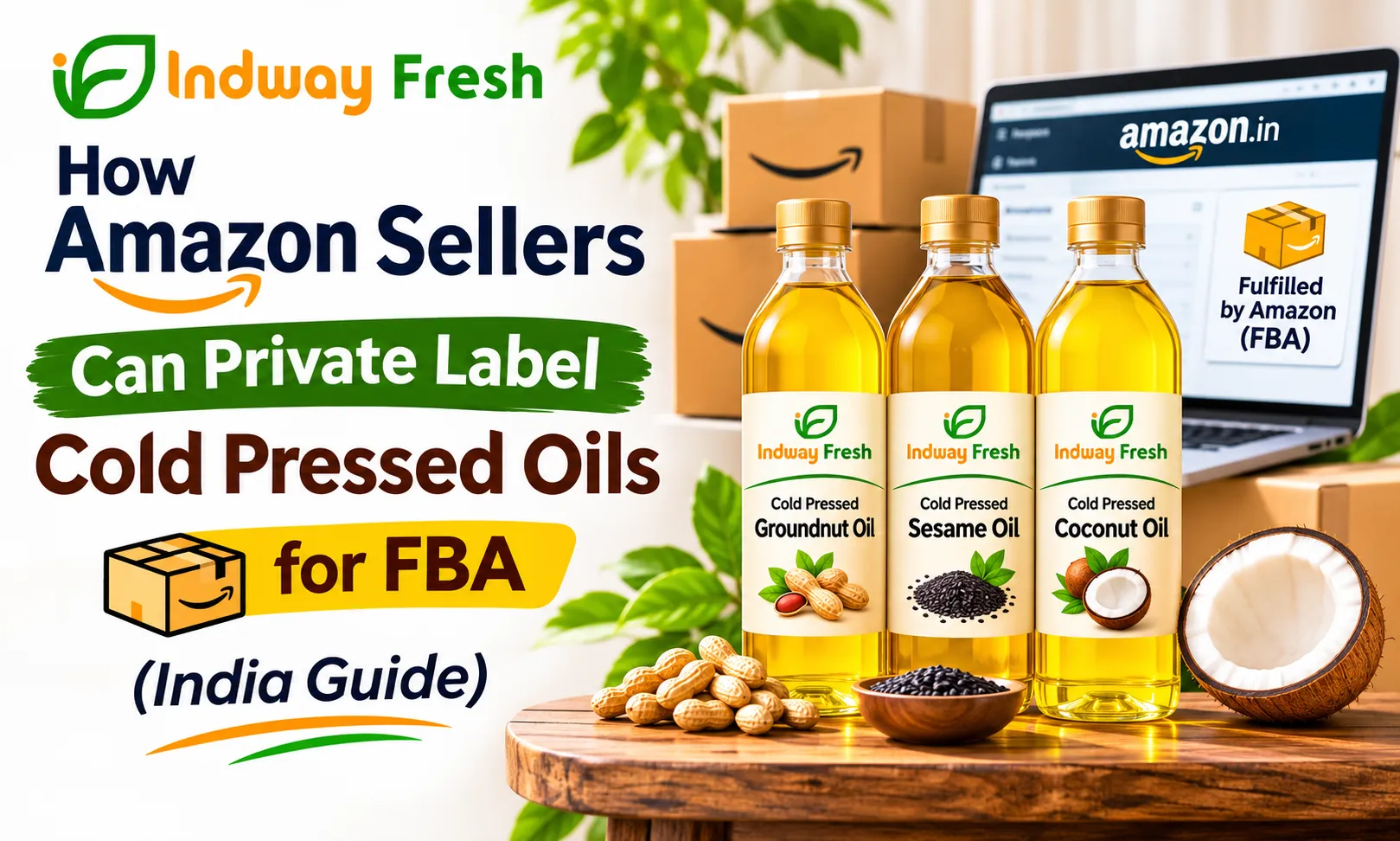
Cold-pressed oils (groundnut, coconut, sesame, and mustard) are a growing category on Amazon India. Buyers search for “wood pressed,” “kachi ghani,” and “chekku” oils, and many are willing to pay more for them. The challenge for sellers is that edible oil is a regulated food category, so FBA needs more preparation than a typical product.
Here is how private labeling works, from choosing a manufacturer to shipping stock into Amazon fulfillment centers.
Why Private Label Cold Pressed Oil on Amazon?
- High repeat purchase: oil is a monthly kitchen staple, so repeat orders and Subscribe & Save work well.
- Brand-led category: buyers choose on trust, purity, and extraction method, so a well-positioned private label brand can compete without a manufacturing plant.
- Low capital entry: you don’t need your own Ghani unit. A certified manufacturer handles extraction, filtering, and filling, and you handle brand, listing, and marketing.
Choose the Right Oils for Amazon
Start with 2–3 SKUs rather than a full range.
| Oil | Why it works on Amazon | Packaging to consider |
|---|---|---|
| Cold-pressed groundnut oil | High search volume, everyday cooking | 1 L, 5 L |
| Cold-pressed coconut oil | Cooking, hair and skin searches | 500 ml, 1 L |
| Cold-pressed sesame (gingelly) oil | Traditional, health-driven buyers | 500 ml, 1 L |
| Cold-pressed mustard oil | Strong in North India | 1 L, 5 L |
Find a Reliable Private Label Manufacturer
Your brand depends on your manufacturer’s quality. Before placing an order, check the following:
- Valid FSSAI license for the manufacturing unit
- True cold press or wood press (kachi ghani) extraction. Ask about process temperature and equipment.
- Lab testing: batch-wise reports, ideally from NABL-accredited labs
- Food safety systems such as HACCP or ISO, if available
- MOQ and lead time. Many manufacturers offer low trial MOQs for new brands.
- Packaging capability: PET bottles, glass, tins, and pouches, and whether they support label printing
- Samples before bulk orders
Get Your Compliance in Place
This is where most new FBA food sellers get delayed.
FSSAI licensing. The rules are specific for FBA:
- Selling food without a valid FSSAI license is illegal in India, and Amazon asks for the license when you list in Grocery & Gourmet.
- FSSAI is a premises-based license, so a seller on Amazon needs a separate FSSAI license for each fulfillment center (FC)
- The license should be in your name or the company name, show the FC address as the business premises, list “Retailer” as the kind of business, and have more than two months of validity remaining.
- The license scope must cover the food categories you plan to sell.
- To send food products to an FC, you need approval to sell foods under the Grocery category.
Your manufacturer holds the manufacturing license. As the brand owner and seller, you need your own license or registration for the retail and FC side.
Other essentials:
- GST registration. You will likely need GST registration in the states where your FCs are located. Confirm this with your CA.
- Label compliance: product name, net quantity, ingredients, batch number, manufacture and best-before dates, FSSAI number, veg symbol, nutrition information, and storage instructions
- Claims: Amazon expects accurate, non-misleading information and no health claims that go beyond FSS Act rules. Avoid “cures,” “heals,” and “diabetes-friendly.”
Design Packaging Built for FBA
Oil is heavy, leak-prone, and fragile in transit, so packaging matters more here than in most categories.
- Leak-proof closures: tamper-evident caps, inner seals, and induction seals
- Material: PET bottles reduce breakage risk. Glass looks premium but needs stronger cartons. This suit is 5 L packs.
- Cartons: sturdy cartons with dividers and a drop test before shipping
- Barcodes: use Amazon’s FNSKU labels, correctly placed
- Shelf life: cold-pressed oils have a limited shelf life, and FBA stock needs enough remaining life when it is received, so plan quantities accordingly
Understand Your Costs Before Launch
| Cost Component | Notes |
|---|---|
| Manufacturing and filling | Per-litre quote from manufacturer [add verified figure] |
| Packaging and labeling | Bottle, cap, label, carton [add figure] |
| FSSAI license(s) | Per FC state, fees vary. |
| Amazon referral fee | Grocery category: check the current fee card. |
| FBA fulfillment and storage fees | Weight- and size-based; check the current rate card. |
| Advertising | Sponsored Products to start |
| Returns and breakage allowance | Keep a buffer |
Launch and Grow
- Start with a small first batch, so you can test reviews and packaging before scaling.
- Run Sponsored Products on keywords like “cold-pressed groundnut oil,” “wood-pressed oil,” and “kachi-ghani oil.”
- Collect reviews through Amazon’s Request a Review feature and quality inserts.
- Add Subscribe & Save for repeat buyers.
- Expand the range with combo packs, then other oils.
- Build off-Amazon demand through your own D2C website, Instagram, and local content to reduce ad dependence.
Common Mistakes to Avoid
- Skipping the FC-specific FSSAI requirement
- Using a manufacturer with no batch testing
- Choosing weak packaging that leaks in transit
- Making unverified health claims
- Launching too many SKUs at once
- Ignoring FBA weight fees in pricing
Frequently Asked Questions
Do I need my own FSSAI license to private label cold-pressed oil for Amazon?
Yes. Your manufacturer holds the production license, but as the seller, you need your own license or registration for the retail side. For FBA, the licence needs to reflect each fulfillment center, as explained above.
Can I sell cold-pressed oil on Amazon without a manufacturing unit?
Yes. Private labeling lets you outsource production to a licensed manufacturer while you own the brand and sales.
Which cold-pressed oil sells best on Amazon India?
Groundnut, coconut, and sesame are usually the strongest starting points. Check current search volume and competition before choosing.
What is the minimum order quantity for private label oil?
It varies by manufacturer and pack size. Ask for trial MOQs and sample batches
How do I stop oil bottles leaking in FBA?
Use induction-sealed, tamper-evident caps, sturdy cartons with dividers, and test-ship a sample carton before bulk dispatch.
Is glass or PET better for FBA oil?
PET is safer for transit. Glass gives a premium look but needs stronger packing and carries a higher breakage risk.
