

-
Vinoth
- Posted on
- Categories:General
- 0 comments
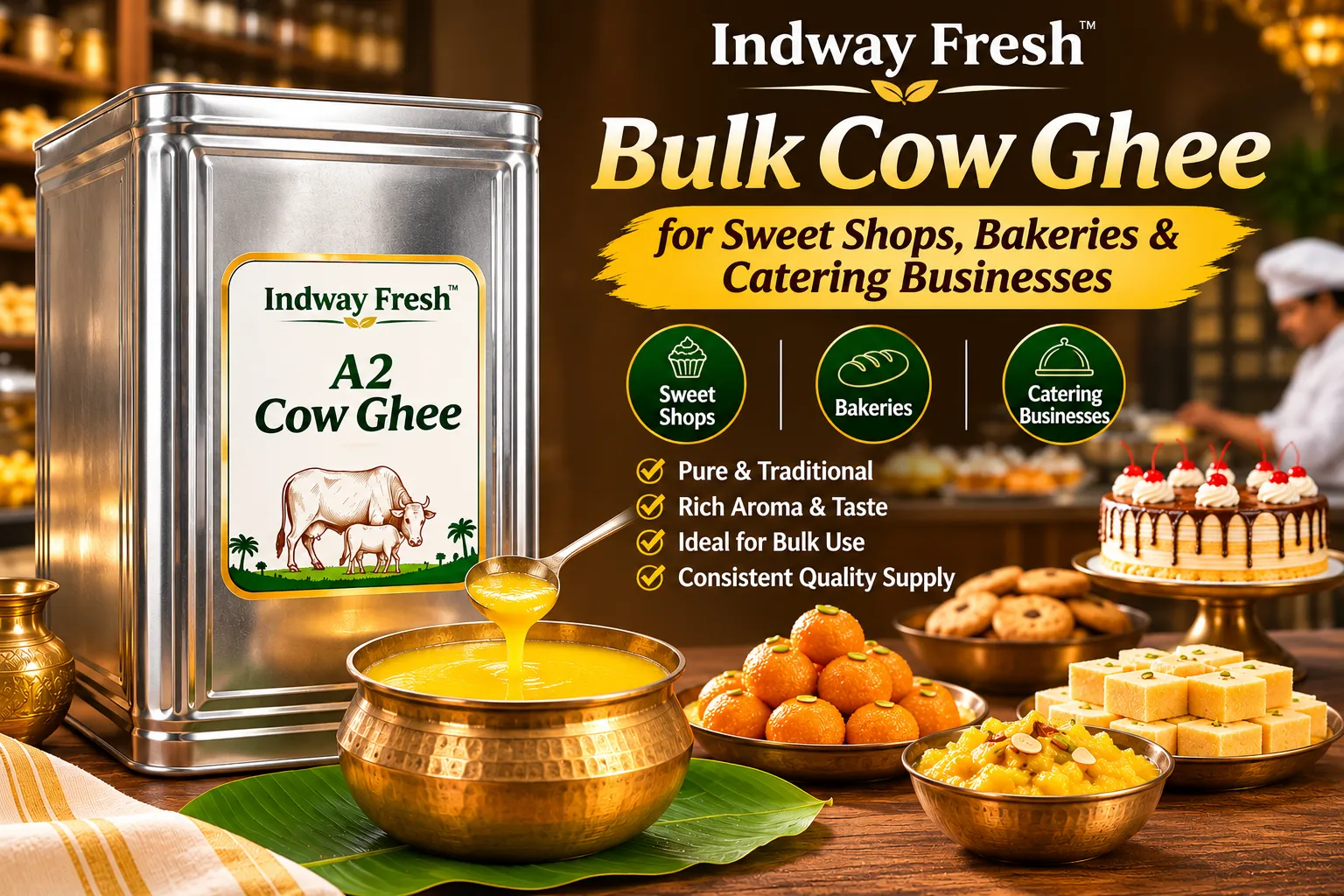
For a sweet shop, a bakery, or a catering kitchen, ghee is not just another ingredient. It sets the aroma of your mithai, the crumb and richness of your bakes, and the taste of every biryani and dessert you serve. A weak batch shows up in the finished product, and your customers notice it.
Indaw Fresh supplies bulk cow ghee to sweet shops, mithai manufacturers, bakeries, caterers, cloud kitchens, HORECA operators, and food manufacturers across India. We also supply export buyers in the UAE, Malaysia, Singapore, the UK, and Canada. We work only with B2B buyers, so our packaging, documentation, dispatch schedules, and pricing are built for commercial volumes.
Why Commercial Kitchens Choose Indaw Fresh Cow Ghee
- Batch-to-batch consistency in aroma, color, texture, and taste, so your signature recipes stay the same every day
- Clean flavor profile suited to sweet-making, baking, frying, and tempering
- High heat stability, with a smoke point well above normal cooking and frying temperatures
- FSSAI-compliant production with batch-wise COA available on request
- Bulk formats designed for kitchens: 15 kg tins, jars, and drums
- Private-label packing for brands, distributors, and retailers
- Scheduled repeat dispatches so you never run short during peak season
Understanding Cow Ghee: What Buyers Should Evaluate
Not all ghee sold in bulk is the same. When comparing suppliers, procurement teams should check these points.
- Milk fat and moisture
Pure ghee is almost entirely milk fat, with very low moisture. Higher moisture shortens shelf life, causes spluttering during frying, and can lead to spoilage. Ask every supplier for the milk fat and moisture figures on their COA. - Free fatty acid (FFA) level
FFA indicates freshness and handling quality. Lower FFA means fresher ghee, a cleaner taste, and a longer shelf life. Rancid or sharp notes in sweets often trace back to high FFA. - Purity parameters
The Reichert-Meissl value and the Butyro-Refractometer (BR) reading help confirm that the ghee is genuine milk fat and not adulterated with vegetable fat. These are standard checks under FSSAI norms. - Aroma and granulation
Traditional-method ghee has a pronounced nutty aroma and a natural grainy (danedar) texture. Cream-method ghee is milder and more uniform. Both are valid. The right choice depends on your product. - Packaging integrity
Food-grade tins and jars with proper seals protect against oxidation, moisture, and light. Poor packaging can ruin good ghee in transit. - Documentation
A reliable supplier provides a valid FSSAI license, batch COA, and complete export paperwork on request. -
Cow Ghee Grades and Variants
- Traditional Cow Ghee (Cultured Butter Method)
Made from cultured curd and butter, then slowly clarified. Rich, nutty, and aromatic with a natural granular set.
Best for: Mysore pak, laddu, halwa, badusha, kaju katli, and other ghee-forward sweets where flavor is the selling point. - Pure Cow Ghee (Cream / Butter Method)
Made from cream or white butter. Clean, mild flavor with uniform texture and efficient production economics.
Best for bakeries, biscuit and cookie makers, high-volume catering, cloud kitchens, and food manufacturers who want consistency at a competitive cost. - Bilona-Style Cow Ghee [confirm availability]
Traditional hand-churned process positioning with premium appeal.
Best for: premium sweet brands, D2C labels, and gifting and export buyers who value a heritage-process story. - Private Label Cow Ghee
Packed under your brand with custom labels, pack sizes, and specifications.
Best for: retail brands, distributors, supermarket chains, exporters, and HORECA suppliers.
- Traditional Cow Ghee (Cultured Butter Method)
Quick Comparison: Which Grade Fits Your Business?
Sweet shop making festival mithai: Traditional cow ghee for maximum aroma and richness.
Bakery or biscuit unit: Pure Cow Ghee (cream method) for uniformity and cost efficiency.
Caterer or cloud kitchen: Pure Cow Ghee for tempering, rice dishes, and desserts at scale.
Premium brand or exporter: Bilona-Style or Private Label for a differentiated product.
How Different Businesses Use Bulk Cow Ghee
Sweet Shops and Mithai Manufacturers
Ghee is typically the single biggest ingredient cost in ghee-based sweets, and it determines taste. Mysore pak depends on ghee quality for its melt-in-mouth texture. Laddu, halwa, and kaju-based sweets need a ghee that blends smoothly without leaving an oily aftertaste. We recommend the traditional grade in 15 kg tins, with planning for Diwali, Pongal, Navratri, Raksha Bandhan, and wedding season, when demand rises sharply.
Bakeries and Confectioners
Ghee-based biscuits, cookies, rusks, cakes, and pastries need a fat that melts predictably and carries flavor without heaviness. Consistent moisture content and a clean taste matter because they directly affect the texture and shelf life of the baked product. Bulk jars and tins reduce repacking and speed up production.
Caterers, Cloud Kitchens, and HORECA
Biryani, pulao, ghee rice, tempering, parathas, and dessert counters use large quantities of ghee daily. Reliable supply at a predictable price matters more here than anything else. We support recurring orders with fixed dispatch schedules, so your kitchen never runs out.
Food Manufacturers and Packaged Food Brands
Ready-to-eat mixes, snacks, spice blends, and sweet-mix manufacturers need ghee with stable specifications and full documentation. We provide batch COA and consistent grade supply for factory use.
Distributors, Retail Brands, and Exporters
Private-label ghee in retail pouches, jars, and tins, with your brand, your label, and the documentation your destination market requires.
Bulk Pack Sizes and Packaging
15 kg tin: standard for sweet shops, caterers, and bakeries
10 L and 5 L food-grade tins/jars: mid-size kitchens and bakeries
1 L and 500 ml jars/pouches: small outlets and retail private label
Drum/bulk supply: manufacturers and large-volume users [confirm sizes]
Export packing: palletized, shrink-wrapped, FCL and LCL-ready, custom labeling on request
All packaging is food-grade, sealed, and designed to protect ghee from moisture, light, and oxidation during transport and storage.
What affects pricing:
- Grade and production method (traditional, cream-method, or bilona-style)
- Pack size and packaging material
- Order volume and delivery frequency
- Private-label and custom-labeling requirements
- Destination and Incoterms (ex-factory, FOB, or CIF)
- Prevailing dairy raw material rates, which fluctuate seasonally
Because ghee prices follow milk and butter market rates, we recommend fixing a monthly or quarterly supply plan. Regular buyers get better price stability and priority dispatch during peak seasons.
Quality Control at Indaw Fresh
- Raw material sourcing from verified dairy suppliers
- Controlled clarification and filtration process
- Laboratory testing for moisture, FFA, and purity parameters before dispatch
- Batch-wise traceability and COA
- Food-grade sealing and tamper-safe packing
- Sample retention for each batch
Storage and Handling Guidelines for Bulk Buyers
- Store sealed tins in a cool, dry place away from sunlight and strong odors
- Keep the lid closed and use a clean, dry spoon or ladle every time
- Avoid contact with water or moisture, which can cause spoilage
- Follow first-in, first-out (FIFO) stock rotation
- Do not store near heat sources such as stoves and ovens
Export Documentation and Compliance
- FSSAI license and food safety compliance
- Certificate of Analysis (COA) per batch
- Certificate of Origin
- Commercial invoice, packing list, and bill of lading
- Health, sanitary, and other certificates as required by the destination country
- Shipping: FCL and LCL, FOB and CIF terms
- Private-label artwork and labeling compliance support
Export Markets
UAE: strong demand from sweet shops, restaurants, and the Indian diaspora retail sector
Malaysia and Singapore: HORECA, Indian restaurants, and packaged food importers
UK and Canada: ethnic grocery distributors, retail brands, and food manufacturers
Labeling, shelf life, and import requirements vary by country. Share your destination, and we will confirm what is needed before you order.
Buyer Checklist: Before You Choose a Bulk Ghee Supplier
- Valid FSSAI license and recent lab reports
- Batch-wise COA and consistent specifications
- Clear MOQ, pricing, and payment terms
- Packaging that suits your usage and storage
- Reliable lead times, especially during festival seasons
- Sample availability before bulk commitment
- Private-label and export support if you need it
Frequently Asked Questions
Do you supply cow ghee in bulk for sweet shops?
Yes. We supply 15 kg tins and larger formats for sweet shops and mithai manufacturers, with scheduled repeat deliveries and planning for festival season.
Which ghee is better for sweets: traditional or cream method?
Traditional-method ghee has a stronger aroma and granular texture, which suits flavor-led sweets like Mysore pak and laddu. Cream-method ghee is milder and more uniform, which suits bakeries, catering, and large-volume use. We can send samples of both so you can test them in your own recipes.
What is the minimum order quantity?
MOQ is. Share your monthly requirement, and we will propose a supply plan that fits.
Can you supply private-label cow ghee?
Yes. We pack under your brand with custom labels and pack sizes. Share your requirements for MOQ and artwork details.
Do you export cow ghee?
Yes. We export to the UAE, Malaysia, Singapore, the UK, and Canada with COA and full export documentation.
What is the shelf life of your cow ghee?
Typically 9 to 12 months in sealed packaging when stored properly
Will the ghee quality stay the same across batches?
Consistency is a core focus. Each batch is tested before dispatch, and a COA is available so you can compare specifications over time.
Can I get a sample before placing a bulk order?
Yes. Samples can be arranged for genuine B2B buyers. Please share your business name, product use, and requirements.
Is your ghee suitable for both sweets and baking?
Yes. Choose the traditional grade for flavour-led sweets and the cream-method grade for bakery and high-volume catering.
Can you supply during Diwali and festival peak seasons?
Yes, with planning. We recommend confirming festival-season volumes 4 to 6 weeks ahead [confirm lead time] so stock and dispatch are secured.
Request a Bulk Quote
Tell us your business type, monthly requirement, preferred grade and pack size, and delivery location. The Indaw Fresh team will respond with pricing, samples, and documentation.
