

-
Vinoth
- Posted on
- Categories:General
- 0 comments
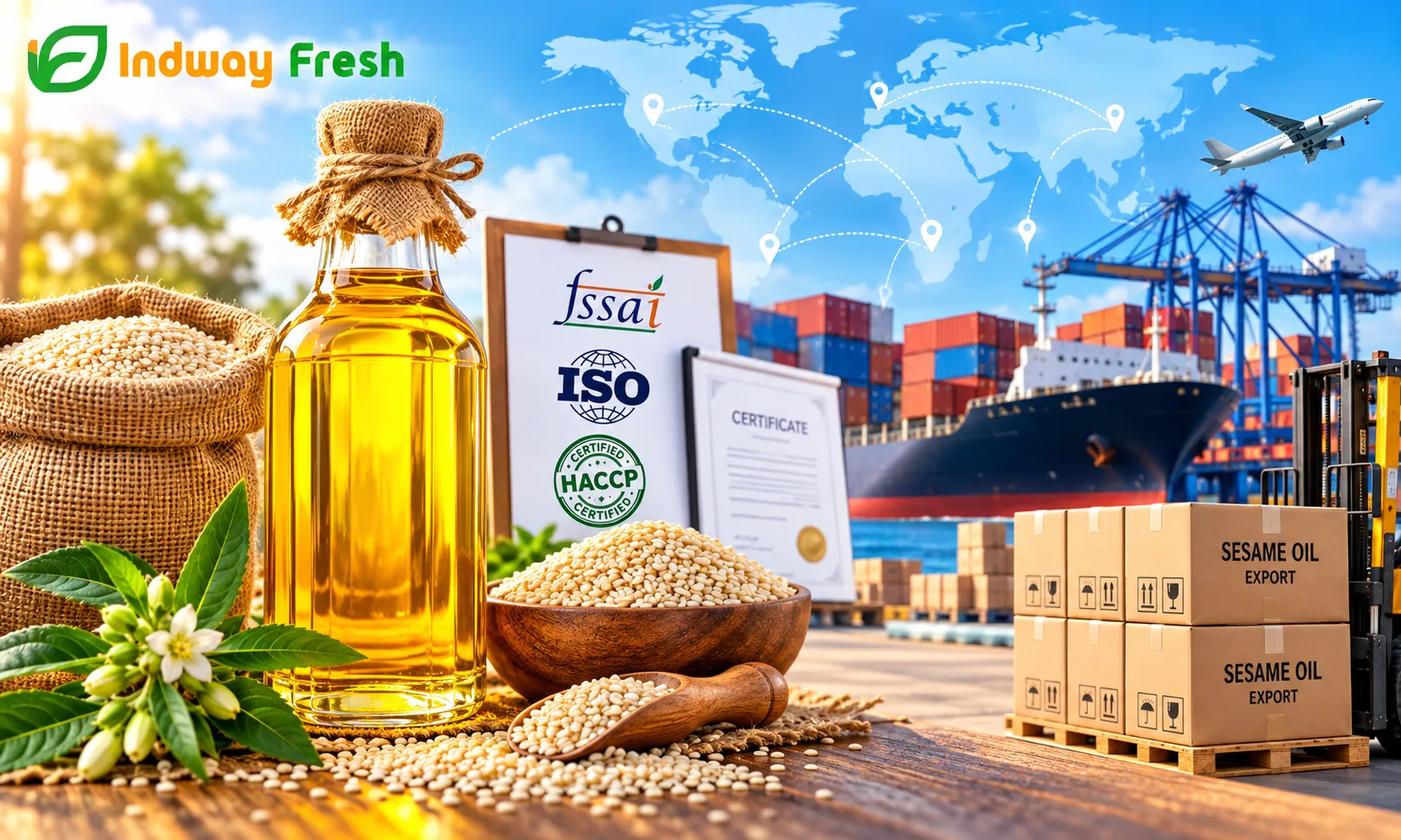
Exporting Sesame (Gingelly) Oil from India: Quality Standards & Buyer Requirements
India is one of the world’s largest producers of sesame seeds, and its cold-pressed gingelly oil occupies a premium position in global edible oil trade. For international buyers—importers, private-label brands, food manufacturers, and distributors—understanding the quality benchmarks and regulatory requirements tied to Indian sesame oil exports is the first step toward a reliable, compliant sourcing relationship.
This guide breaks down what quality-conscious buyers look for, what Indian exporters are expected to deliver, and how Indaw Fresh aligns with those standards.
Why Indian Sesame Oil Commands Global Attention
India’s sesame cultivation spans Tamil Nadu, Rajasthan, Gujarat, and Andhra Pradesh—regions with distinct seed varieties that yield oils with differing flavor profiles, color intensities, and fatty acid compositions. The wood-pressed (chekku) extraction method, still widely practiced in South India, produces a full-flavored, unrefined oil that commands premium positioning in markets like Malaysia, Singapore, the UAE, and the UK, where Indian diaspora communities and health-conscious consumers both drive demand.
Cold-pressed or wood-pressed gingelly oil retains its natural antioxidants, sesamin, and sesamolin content—bioactive compounds largely lost in refined variants. This makes it attractive not just as a cooking oil but as a value-add ingredient for food manufacturers and nutraceutical-adjacent product lines.
Key Quality Parameters That Buyers Check
Before issuing a purchase order, serious import buyers—especially those operating in regulated markets like the UK, Canada, or the EU—will request a Certificate of Analysis (COA) covering the following:
Acid Value (AV)
A measure of free fatty acid content, directly tied to freshness and correct processing. Cold-pressed sesame oil exported from India should typically present an acid value below 2.0 mg KOH/g. Higher values suggest poor seed quality, delayed processing, or inadequate storage.
Peroxide Value (PV)
Measures oxidative deterioration. Buyers expect a peroxide value below 10 meq O₂/kg for fresh, export-grade oil. Any deviation signals rancidity risk during transit—a major quality concern for FCL shipments crossing 20+ days at sea.
Moisture and Volatile Matter
Should be below 0.2% for unrefined cold-pressed gingelly oil. Elevated moisture accelerates microbial activity and reduces shelf life.
Iodine Value
Confirms the oil’s fatty acid profile and helps verify authenticity. Genuine sesame oil has an iodine value typically in the range of 103–116 g I₂/100 g.
Color and Appearance
Unrefined cold-pressed gingelly oil ranges from golden amber to a deep brownish-yellow, depending on seed roasting practice and variety. Buyers should specify whether they require raw (unroasted seed) pressed oil or roasted sesame oil, as these are distinct products with different flavor and color profiles.
Heavy Metals Panel
Regulated markets—particularly the UK post-Brexit and Canada under CFIA guidelines—require testing for lead, cadmium, arsenic, and mercury. NABL-accredited lab reports are the accepted standard for Indian exporters.
Pesticide Residue
Increasingly, EU-aligned buyers are demanding MRL (Maximum Residue Level) compliant test reports. Buyers sourcing for organic private-label lines will additionally require organic seed certification and segregated processing documentation.
Regulatory and Documentation Requirements
For Indian sesame oil to legally enter target markets, the following export documentation is standard:
FSSAI License—Mandatory for all food product manufacturers and exporters in India. Buyers should confirm the exporter’s FSSAI registration number and ensure it is valid and current.
Phytosanitary Certificate—Issued by the Plant Quarantine authority, required by most importing countries to certify the product is free from pests and plant diseases.
Certificate of Origin (COO)—Issued by the Chamber of Commerce. Necessary for customs clearance and to avail preferential duty rates under trade agreements.
COA from NABL/FSSAI-Accredited Lab — A third-party lab report carries more buyer confidence than an in-house test. NABL accreditation is the benchmark buyers in regulated markets will expect.
APEDA Registration — Exporters registered with APEDA (Agricultural and Processed Food Products Export Development Authority) can access export promotion schemes and are recognized by import authorities in many countries as credible, government-registered suppliers.
HACCP / GMP / ISO 22000 Certification—For buyers supplying retail chains or food service accounts in the UK, UAE, or Canada, supplier-side HACCP and GMP documentation is often a non-negotiable prerequisite.
Packaging Options for Export
The choice of packaging affects transit stability, compliance, and end-use application.
Bulk liquid export: HDPE drums (200-liter) or IBC totes (1,000-liter) are standard for B2B wholesale buyers, food manufacturers, and oil bottlers. Food-grade lining and tamper-evident seals are expected.
Retail-ready bulk: For importers who bottle under their own label, Indaw Fresh can supply in bulk with co-packing or private-label service available upon request—in glass bottles, HDPE bottles, or flexible pouches per buyer specification.
BOPP pouch packs: Increasingly popular for foodservice channels in Southeast Asia, typically in 500 ml–5 litre configurations.
All packaging formats should carry FSSAI-compliant labeling, including best-before date, batch number, origin declaration, and nutritional information where required by the destination country.
What Serious Buyers Ask Before Placing a First Order
Procurement managers evaluating Indian sesame oil suppliers typically run through a standard checklist before releasing an LOI or sample order:
Is the acid value and peroxide value within spec? — Request the COA.
What is the extraction method—cold-pressed, wood-pressed, or solvent-extracted? — This determines quality tier and pricing.
What is the MOQ for FCL and LCL shipments? — Buyers operating at different volume scales need flexible entry points.
Can the supplier support private-label and custom packaging? — A significant portion of international sesame oil buyers want their own brand identity on the product.
What are the payment terms—LC, TT, or DP?—First-time buyers usually require secure payment structures.
What is the lead time from order confirmation to the cargo-ready date? — Critical for supply chain planning in markets like the UAE and Singapore, where shelf availability is tightly managed.
Indaw Fresh: Aligned to Global Buyer Standards
At Indaw Fresh, we source sesame seeds from established cultivation belts across South and West India and process gingelly oil using traditional wood-pressed (chekku) extraction. Every batch is tested against standard quality parameters and backed by a COA from an accredited lab. We are FSSAI-licensed, APEDA-registered, and equipped to handle both bulk B2B orders and private-label packaging requirements.
We supply to importers, food manufacturers, distributors, and wholesale buyers across the UAE, Malaysia, Singapore, the UK, and Canada. Our team understands the documentation demands of each target market and can prepare a complete export compliance package alongside every shipment.
If you are an importer or buyer evaluating Indian sesame oil suppliers, we welcome inquiries for samples, COA, and ex-factory or FOB pricing. Contact the Indaw Fresh export team to discuss your volume, specification, and packaging requirements.
