

-
Vinoth
- Posted on
- Categories:General
- 0 comments
By Indway Fresh | Madurai, Tamil Nadu
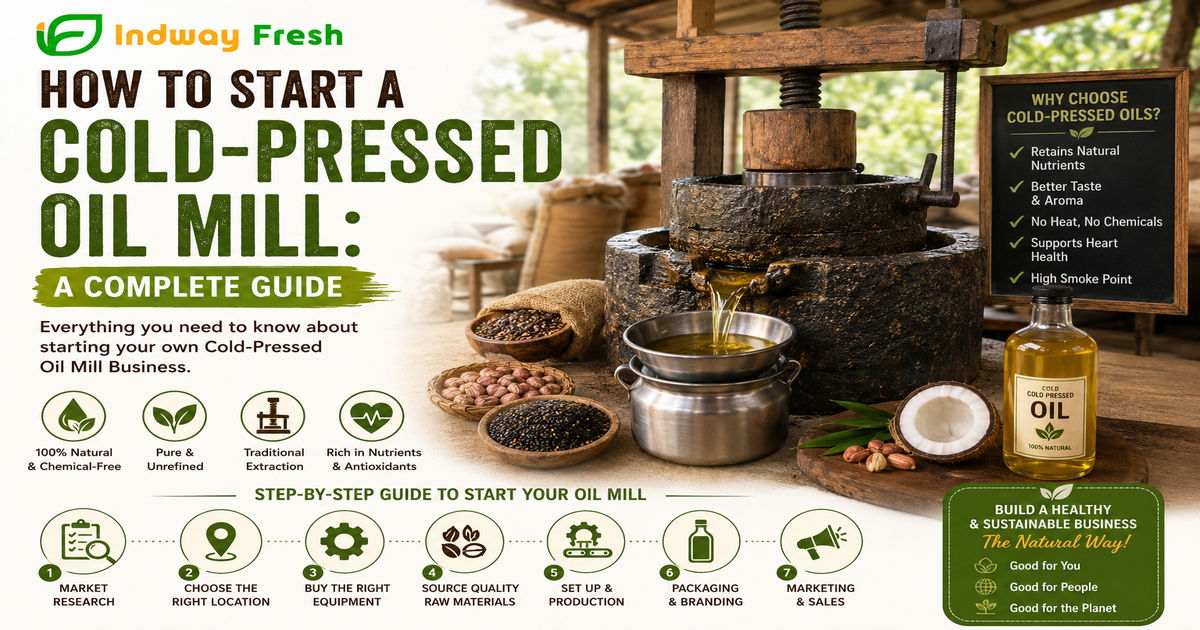
Starting a cold-pressed oil mill is one of the most rewarding agribusiness ventures in India today. With rising consumer awareness around chemical-free, traditionally extracted oils the demand for genuine Chekku / Kachi Ghani oil has never been stronger. Whether you’re planning a small village unit or a mid-scale production facility, this guide walks you through every step.
Why Cold-Pressed Oil Business Makes Sense in 2025
The Indian edible oil market is shifting. Consumers are actively moving away from refined and solvent-extracted oils toward wood-pressed, single-seed, unrefined oils that retain their natural nutrients, aroma, and flavor.
Key reasons to enter this space:
- Growing D2C and HoReCa demand for authentic cold-pressed oils
- Premium pricing — cold-pressed oils command 2x–4x the price of refined alternatives
- Low entry barrier for small-scale mills with Chekku/Kolhu machinery
- Government support via MSME, PMEGP, and ODOP schemes
- Export potential via APEDA-registered channels
Step 1: Choose Your Oil Type and Market
Start by deciding what you’ll press. Popular options in South India include:
| Oil Type | Seed Source | Best Market |
|---|---|---|
| Groundnut Oil | Local farmers, Mandis | Retail, HoReCa, D2C |
| Coconut Oil | Tamil Nadu, Kerala belts | Premium D2C, Export |
| Sesame (Gingelly) Oil | Tirunelveli, Rajasthan | Festivals, Traditional buyers |
| Safflower Oil | Maharashtra, Karnataka | Health-conscious urban buyers |
| Sunflower Oil | Andhra Pradesh, Karnataka | Wholesale, Institutions |
Tip from Indway Fresh: We started with groundnut and sesame — both have strong local demand in Tamil Nadu and shorter ROI cycles.
Step 2: Select the Right Machinery
For cold-pressed oil, the key rule is no heat, no chemicals, no solvent extraction.
Machine Options:
Traditional Chekku (Wood Press / Ghani)
- Animal-driven or motor-driven wooden press
- Authentic cold-press, zero heat generation
- Output: 15–30 litres/day per unit
- Best for artisanal and premium D2C positioning
Steel Expeller (Low-RPM Cold Press)
- Motor-driven steel screw press at controlled low RPM
- Output: 50–200 litres/day
- Cost: ₹1.5L – ₹4L per machine
- Scalable for small to mid commercial units
Multi-seed Cold Press Units
- Can handle groundnut, sesame, sunflower, safflower in one machine
- Suitable for diversified product portfolios
At Indway Fresh, our Madurai facility uses a combination of traditional Chekku presses for artisanal lines and low-RPM expellers for wholesale output maintaining quality without compromising on volume.
Step 3: Set Up Your Unit — Space and Infrastructure
A basic cold-pressed oil mill needs:
| Requirement | Details |
|---|---|
| Space | Minimum 500–1000 sq ft |
| Power | 3-phase connection, 5–10 HP load |
| Water | Cleaning, seed soaking (minimal) |
| Storage | Seed storage room + finished goods room |
| Drainage | Oil waste and press cake disposal |
Keep your unit clean, dry, and pest-free this is critical for FSSAI compliance.
Step 4: Licenses and Registrations
This is non-negotiable. Here’s the compliance checklist:
| License | Authority | Purpose |
|---|---|---|
| FSSAI License | Food Safety and Standards Authority of India | Mandatory for any food business |
| MSME / Udyam Registration | Ministry of MSME | Access to subsidies, bank loans |
| GST Registration | GST Council | For B2B invoicing and ITC |
| Trade License | Local Municipality | Premises clearance |
| APEDA Registration | Agricultural & Processed Food Products Export Development Authority | Required for exports |
| NABL-Accredited Testing | Third-party lab | For quality certificates to B2B buyers |
Pro Tip: Apply for FSSAI first — it unlocks most other registrations downstream.
Step 5: Source Quality Seeds
Your oil is only as good as your seeds. Cold-press oils have no chemical masking bad seeds = bad oil.
Key sourcing principles:
- Buy from farmers or mandis, not traders (fewer middlemen = fresher seeds)
- Prioritize non-GMO, pesticide-free sources especially for export and premium D2C
- Build direct farmer relationships for consistent MOQ supply
- Store seeds in cool, dry, ventilated rooms to prevent mold
At Indway Fresh, we source groundnut seeds from verified Madurai-region farmers and sesame from Tirunelveli traceability is part of our brand promise.
Step 6: Production Process Step by Step
Cold-pressed oil extraction is simple but requires discipline:
- Seed Cleaning
- Remove dust, stones, and foreign matter
- Seed Drying
- Sun-dry or low-heat dry to optimal moisture level
- Pre-conditioning
- Minimal warming (only if needed, max 40°C) to improve flow
- Pressing
- Feed into Chekku or expeller; oil flows out naturally
- Settling / Gravity Filtration
- Let oil settle for 24–48 hours to remove sediment
- Filtration
- Filter through muslin or food-grade filter press
- Bottling
- Fill into HDPE or glass bottles under clean conditions
- Labeling
- FSSAI-compliant label with batch no., MFG date, EXP date, nutritional info
No bleaching. No deodorization. No hydrogenation. That’s the cold-press promise.
Step 7: Packaging and Branding
Cold-pressed oil is a premium product your packaging must reflect that.
Packaging options:
- 500ml / 1L HDPE bottles — retail and D2C standard
- 5L / 15L tins or cans — HoReCa and wholesale
- Glass bottles — for premium D2C and export
Branding musts:
- Clearly state: “Cold-Pressed / Chekku Extracted / Kachi Ghani”
- Add “Unrefined | No Preservatives | No Additives”
- Include FSSAI license number on every label
- Batch traceability and QR codes build buyer trust
Step 8: Sales Channels Where to Sell
| Channel | Best For |
|---|---|
| D2C Website / Amazon / Flipkart | Premium retail buyers |
| Organic and Natural Food Stores | Local retail push |
| HoReCa — Hotels, Restaurants, Caterers | High-volume, repeat orders |
| Wholesale / Distributors | Scale and reach |
| Export via APEDA | Premium margins, US/Middle East/EU markets |
| Private Label Supply | B2B — supply to brands under their label |
Indway Fresh operates across all these channels from our Madurai base — supplying private label cold-pressed oils to brands across South India, while building our own D2C presence at indwayfresh.com.
Estimated Investment Breakdown (Small-Scale Unit)
| Item | Estimated Cost |
|---|---|
| Machinery (2 units) | ₹3L – ₹6L |
| Space Setup / Rental (6 months) | ₹1L – ₹2L |
| Seed Stock (initial) | ₹1L – ₹2L |
| Packaging Materials | ₹50K – ₹1L |
| Licenses and Registrations | ₹25K – ₹50K |
| Branding and Website | ₹25K – ₹75K |
| Total Estimated Investment | ₹6L – ₹12L |
Costs vary by location, scale, and machinery choice. PMEGP subsidy can offset 15–35% of project cost.
Why Partner with Indway Fresh?
If you’re entering the cold-pressed oil space and need a reliable manufacturing and private label partner, Indway Fresh is your answer.
- ✅ Chekku and expeller cold-press production in Madurai
- ✅ FSSAI-compliant manufacturing
- ✅ Private label with custom branding — MOQ flexible
- ✅ Groundnut, sesame, coconut, sunflower, and safflower oil
- ✅ Pan-India B2B supply and export-ready packaging
📞 Contact Indway Fresh: indwayfresh.com
FAQs
Q: What is the minimum investment to start a cold-pressed oil mill?
A: A small-scale unit can be started with ₹6L–₹12L. With PMEGP support, effective investment can be lower.
Q: Is cold-pressed oil business profitable?
A: Yes. Premium pricing (₹300–₹800/litre retail) against lower input costs makes margins strong, especially in D2C and export channels.
Q: What FSSAI license do I need?
A: FSSAI State License for production above 12 MT/year. Below that, Basic Registration applies. Consult your state food authority.
Q: Can I do private label supply without my own mill?
A: Yes — manufacturers like Indway Fresh offer contract manufacturing and private label with flexible MOQ.
Q: Which oil is most profitable to press?
A: Sesame (gingelly) and coconut oil command the highest retail premiums. Groundnut has the widest market.
