

-
Vinoth
- Posted on
- Categories:General
- 0 comments
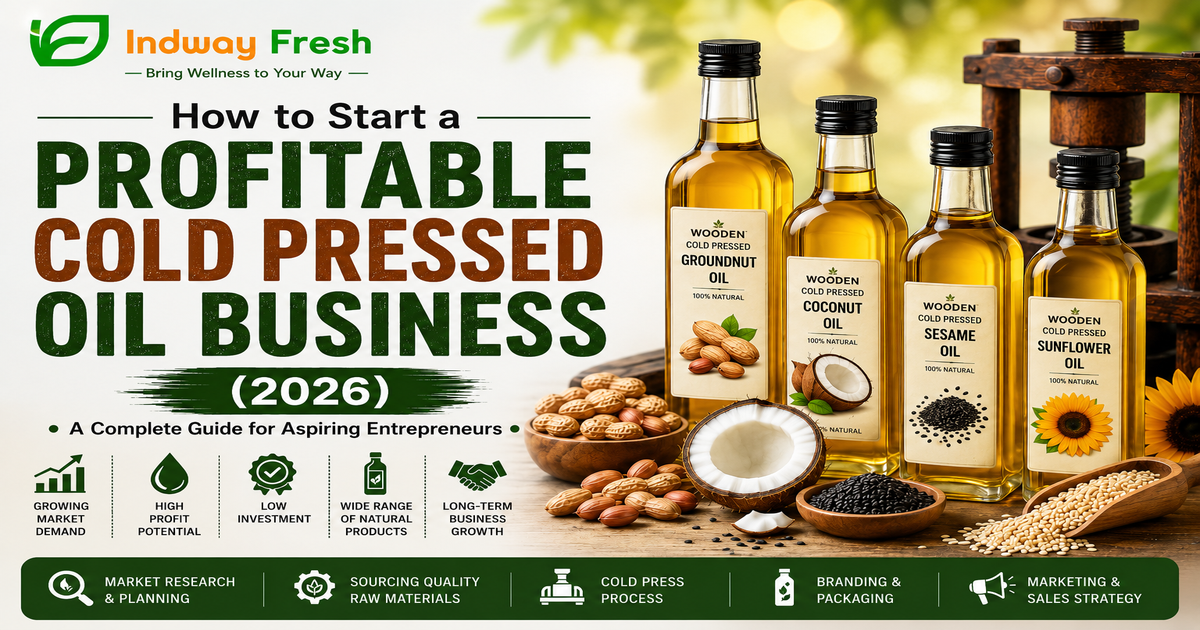
A Practical Guide by Indway Fresh — Cold Pressed Oil Manufacturer, Madurai, Tamil Nadu
indwayfresh.com
The cold pressed oil market in India is no longer a niche. Health-conscious buyers, premium grocery chains, and D2C brands are all pulling demand upward and the gap between a ₹50 refined oil pouch and a ₹300 cold pressed bottle has never been more visible. If you have been thinking about entering this space, 2026 is arguably the best window yet.
This guide walks you through everything you need — from understanding the extraction process to getting your first commercial batch out the door.
What Is Cold Pressed Oil, and Why Does It Sell?
Cold pressed oil is extracted using a slow, mechanical press no heat, no chemical solvents. The oil retains its natural fatty acid profile, antioxidants, vitamins, and aroma. That is what you are paying for when you buy a bottle of Chekku groundnut oil or Kachi Ghani mustard oil not just taste, but nutritional integrity.
Refined oils dominate volume, but cold pressed dominates margin. Customers who understand the difference are willing to pay a 3x to 5x premium, and they come back repeatedly.
Step 1: Choose Your Oil Category
Not all cold pressed oils are equal in terms of demand, raw material availability, and margin.
| Oil | Raw Material | Consumer Demand | Margin Potential |
|---|---|---|---|
| Groundnut (Chekku) | Readily available in TN, AP | Very high South India staple | High |
| Coconut (Virgin) | Tamil Nadu, Kerala | Strong D2C and export demand | Very high |
| Sesame (Gingelly) | AP, TN | High temple, traditional use | High |
| Sunflower | Widely available | Growing health positioning | Medium-High |
| Safflower | Maharashtra, Karnataka | Niche but premium | High |
| Mustard (Kachi Ghani) | North India sourcing needed | Strong in North/East markets | Medium |
For a Tamil Nadu-based startup: Groundnut, coconut, and sesame are the lowest-friction entry points. Raw material procurement is local, cold press yield is predictable, and buyer demand is established.
Step 2: Understand the Extraction Methods
Chekku / Kolhu pressing The traditional rotary wooden or stone press. Runs at very low RPM, generates minimal heat (below 40–45°C), and preserves the oil’s flavour and nutrients intact. Gold standard for South Indian groundnut and sesame oil.
Expeller cold pressing Modern stainless-steel expeller presses running at controlled speeds. Faster throughput, easier to scale, easier to clean, and FSSAI-compliant. Preferred for commercial production runs above 200 litres/day.
Both methods qualify as “cold pressed” if temperature is maintained under 49°C. Your production SOP should document and monitor temperature at the press head.
Step 3: Register Your Business and Get Compliances in Place
Essential registrations:
- FSSAI License Mandatory for all food businesses. Basic Registration up to ₹12 lakh annual turnover; State License from ₹12 lakh to ₹20 crore. Category: edible vegetable oils.
- MSME / Udyam Registration Opens government schemes, lower-interest loans, and priority procurement benefits.
- GST Registration Required once turnover crosses threshold. Oil for human consumption attracts 5% GST.
- BIS/AGMARK Not mandatory for all categories, but AGMARK certification strengthens buyer trust for groundnut and mustard oil.
- IEC (Import Export Code) Required if you plan to export or work with APEDA-registered buyers. Apply through DGFT.
For export readiness: APEDA registration and NABL-accredited lab test reports are required by international buyers. Build these into Year 1 planning even if export is a Year 2 goal.
Step 4: Set Up Your Production Unit
Space requirements:
500–800 sq ft is workable for small-batch (50–150 litres/day). Commercial scale (500+ litres/day) needs 2,000 sq ft or more with dedicated raw material store, press room, filtration area, filling station, and cold storage.
Core equipment:
- Cold press expeller (capacity-matched to volume target)
- Seed cleaning and roasting unit (optional but improves yield and flavour)
- Oil filter press or centrifuge
- Filling and sealing machine
- Food-grade storage tanks, stainless bottling bench
Capital estimate (indicative):
- Small batch unit (50–100L/day): ₹8–15 lakh setup
- Mid-scale (200–500L/day): ₹25–50 lakh setup
Indicative ranges only. Get 3 quotes from local equipment suppliers and factor in civil work, electrical, and working capital separately.
Step 5: Source Raw Materials Reliably
The biggest hidden risk in cold pressed oil production is raw material inconsistency. Moisture content, aflatoxin levels, and oil yield percentage vary by crop season, region, and storage condition.
Build your procurement system around:
- Fixed-rate agreements with 2–3 farmers or aggregators
- Incoming quality checks moisture meter, extraction yield test on small sample
- NABL-lab tests for aflatoxin (groundnut especially) before bulk processing
- Covered dry warehouse to protect seed quality
South Tamil Nadu is strong for groundnut (Virudhunagar, Sivakasi belt) and sesame (Tirunelveli, Thoothukudi). Coconut sourcing from Pollachi, Coimbatore belt is well-established.
Step 6: Design Your Brand and Packaging
Your label must clearly communicate:
- Extraction method (Cold Pressed / Chekku / Kachi Ghani)
- Seed variety and origin if premium (e.g., “Pollachi Coconut,” “Tirunelveli Sesame”)
- FSSAI license number
- Batch number and manufacturing / best before dates
- Net weight and MRP
Bottle formats that sell:
- 500ml and 1L for retail
- 5L HDPE jars for bulk/family packs
- 250ml for gifting and premium D2C
Glass bottles justify a premium price but increase logistics fragility and cost. PET food-grade bottles are more practical for first-year scale.
Step 7: Choose Your Sales Channels
| Channel | Margin | Volume | Payment Cycle |
|---|---|---|---|
| D2C (own website + WhatsApp) | Highest | Slow to build | Immediate |
| E-commerce (Amazon, Flipkart, Blinkit) | Medium (after 15–25% commission) | High reach | 7–14 days |
| Modern Trade / Organic Stores | Medium (25–35% trade margin) | Steady | 30–45 days |
| HoReCa | Lower | Consistent bulk | 30–60 days |
| B2B Wholesale / Private Label | Lowest per litre | Highest volume | As per contract |
Step 8: Price Your Oil for Profitability
MRP = Raw material cost + Processing cost + Packaging cost + Overhead allocation + Target margin
For 1L cold pressed groundnut oil, a ₹250–350 MRP range is commercially viable and competitive at current input prices. Verify live raw material costs before finalising your pricing sheet.
Target net margin: 25–35% at mid-scale production.
Step 9: Build Repeat Purchase Systems
Cold pressed oil is a consumable. Business value is in repeat purchase, not first purchase.
- WhatsApp subscription model monthly delivery at a small discount
- Family pack bundles (5L jar) with free delivery above ₹500
- Combo packs coconut + sesame + groundnut sampler
- Educational content recipes, health benefits, oil pulling guides
Why Partner with an Established Manufacturer?
If your capital is limited or you want to test the market before investing in a production unit, a private label arrangement with an established manufacturer is a viable path. You focus on branding, sales, and distribution. The manufacturer handles extraction, filtration, and quality.
Indway Fresh, Madurai manufactures cold pressed groundnut, coconut, sesame, sunflower, and safflower oils available for private labelling, bulk wholesale, and D2C supply partnerships across India.
📩 Reach us at indwayfresh.com
Frequently Asked Questions
What is the MOQ for private label cold pressed oil?
Typically 100–500 litres per SKU per order. Verify directly with your supply partner.
Is cold pressed oil business profitable in India?
Yes net margins of 25–40% are achievable at mid-scale with strong D2C or B2B channels. Margin depends heavily on raw material procurement and channel mix.
Do I need a separate FSSAI license for each oil variety?
No. One FSSAI license covers the edible vegetable oil category. Each batch must be individually documented and labelled.
Can I export cold pressed oil from India?
Yes. You need IEC from DGFT, APEDA registration, and NABL lab reports. Popular export destinations: Middle East, USA, UK, Southeast Asia. Pricing quoted FOB in USD.
What is the shelf life of cold pressed oil?
Typically 6–12 months from manufacturing date when stored cool and dark. Coconut oil is more stable; groundnut and sesame are more sensitive to heat and light.
