

-
Vinoth
- Posted on
- Categories:General
- 0 comments
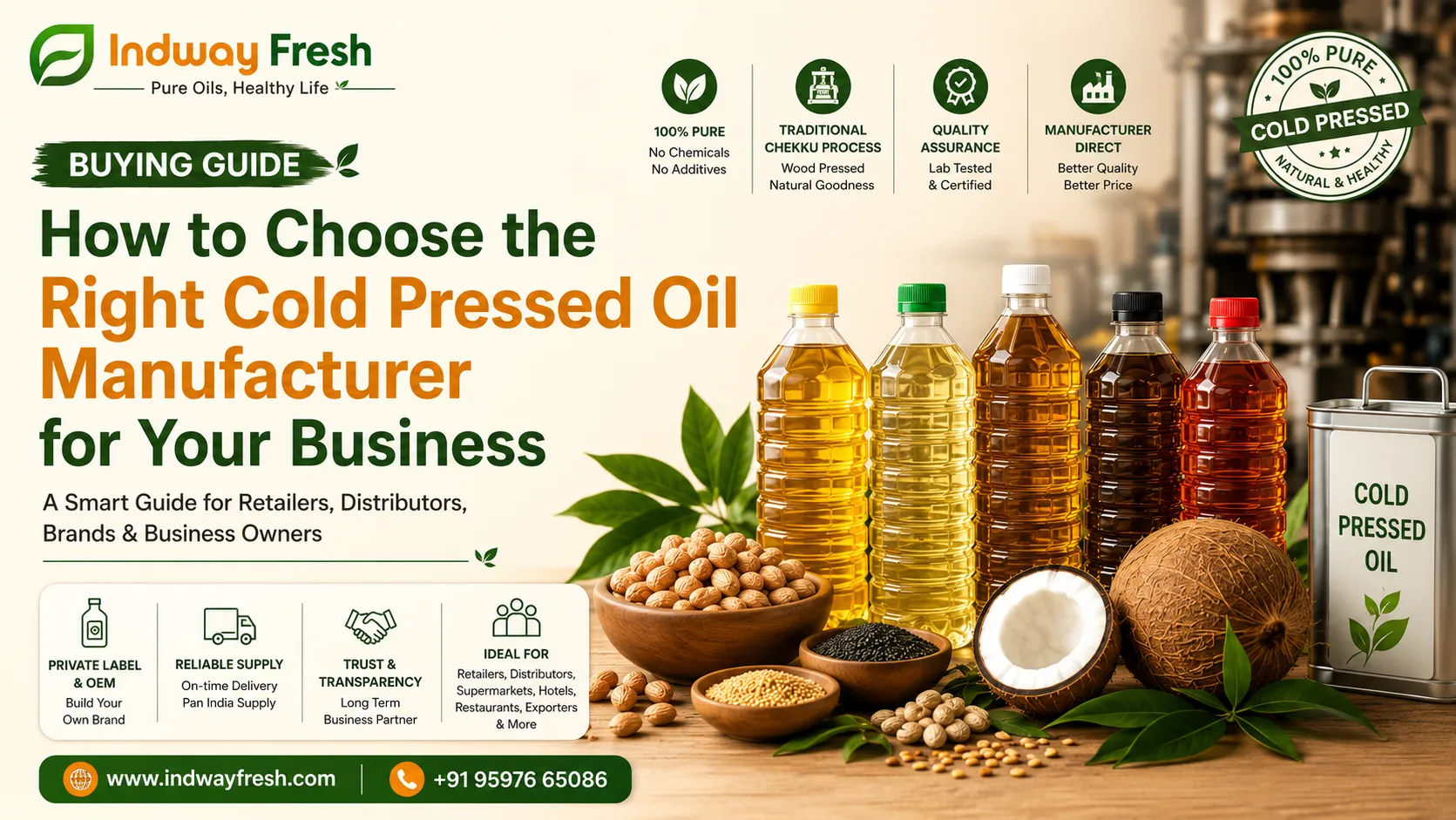
Buying Guide: How to Choose the Right Cold Pressed Oil Manufacturer for Your Business
Sourcing cold pressed oil in bulk is very different from buying a bottle off a retail shelf. Whether you run a restaurant, a HoReCa supply chain, a private label FMCG brand, or an export business, the manufacturer you partner with directly affects your product quality, your margins, and your compliance record. This guide walks you through exactly what to check before signing a purchase order.
Why the Right Manufacturer Choice Matters
A cold pressed oil manufacturer isn’t just a vendor — they’re an extension of your quality promise to your customers. Get it wrong, and you inherit their problems: inconsistent batches, missed delivery windows, non-compliant labeling, or oil that doesn’t match the “cold pressed” claim on your packaging. Get it right, and you get a reliable, scalable supply partner who can grow with your business.
1. Verify FSSAI Certification and Compliance Documents
This is non-negotiable. Any legitimate cold pressed oil manufacturer in India must hold a valid FSSAI license appropriate to their production scale (State or Central, depending on turnover and business type). Before you go further:
- Ask for the FSSAI license number and cross-check it on the FSSAI portal.
- Request lab test reports (peroxide value, free fatty acid, moisture content) for the specific oil you intend to buy.
- For export orders, confirm whether the manufacturer has experience with export documentation and phytosanitary/quality certificates where applicable.
2. Understand Their Extraction Method
“Cold pressed” is a widely used term, but not all cold pressed oil is produced the same way. Ask specifically:
- Do they use a traditional wooden Chekku/Kolhu (Ghani) process, or a modern low-heat expeller?
- What temperature does the extraction run at? True cold pressing stays well below the heat threshold that damages nutrients and flavor.
- Is the oil filtered mechanically (sediment settling) or chemically refined afterward? A genuine cold pressed product should involve no chemical refining, bleaching, or deodorizing.
A manufacturer who can clearly explain their process — and show you the mill — is generally more trustworthy than one who deflects the question.
3. Check Product Range and Raw Material Sourcing
- Which oils do they produce: coconut, groundnut, sesame, mustard, castor, neem, and so on?
- Where do they source raw seeds/copra/nuts from? Traceable, regional sourcing (for example, Tamil Nadu-grown coconut or groundnut) is often a sign of quality control upstream, not just at the pressing stage.
- Can they maintain batch consistency across large orders, or does quality vary seasonally?
4. Ask About MOQ, Pricing Structure, and Custom Options
Every manufacturer structures bulk orders differently. Get clarity on:
- Minimum Order Quantity (MOQ): Some manufacturers accommodate small business orders with no strict minimum, while others require bulk-only commitments.
- Pricing tiers: Wholesale pricing usually scales with volume. Ask for a tiered price sheet rather than a single flat rate.
- Private labeling costs: If you want your own brand on the bottle, ask whether label design, bottling, and packaging are included or billed separately.
5. Evaluate Packing, Bottling, and Private Label Capability
- What packing sizes are available — from retail bottles to bulk tins/drums for HoReCa and industrial buyers?
- Can they do private label runs (your brand, your bottle design), or only supply loose/bulk oil?
- Is the packaging food-grade and suitable for the oil type (dark glass or opaque containers help preserve quality and shelf life)?
6. Confirm Delivery Timelines and Logistics
- What’s their standard delivery window for bulk orders to your city or state?
- Do they handle nationwide shipping, or only regional dispatch?
- For export buyers: do they manage freight and export documentation, or is that entirely on you?
7. Look for a Track Record, Not Just a Sales Pitch
- Ask for references from existing B2B clients — restaurants, retailers, or other private label brands they already supply.
- Look for manufacturers with an established manufacturing unit (not just a trading/reselling setup) — this usually means better quality control and consistency.
- A manufacturer with years of operating history and a physical facility you can verify is generally a safer long-term partner than one operating purely online with no traceable production base.
8. Communication and After-Sales Support
Bulk sourcing is a relationship, not a one-time transaction. Before committing:
- Test their responsiveness during the inquiry stage — this is usually a preview of how they’ll handle issues after the order.
- Ask how they handle quality complaints, short shipments, or delays.
- Confirm whether they offer a dedicated point of contact for B2B accounts.
Quick Checklist Before You Order
| What to Verify | Why It Matters |
|---|---|
| Valid FSSAI license | Legal compliance, avoids regulatory risk |
| Lab test reports | Confirms purity and quality claims |
| Extraction method (Chekku/Kolhu vs expeller) | Determines true “cold pressed” authenticity |
| Raw material sourcing | Impacts consistency and traceability |
| MOQ and pricing tiers | Affects your unit economics |
| Private labeling capability | Needed if you’re building your own brand |
| Packing sizes available | Must match your business use case (retail/HoReCa/export) |
| Delivery timelines | Impacts your inventory planning |
| Client references | Validates reliability at scale |
Frequently Asked Questions
Q: How do I verify a manufacturer’s FSSAI license is genuine? A: You can check the license number on the official FSSAI portal (foscos.fssai.gov.in), which shows the license status and registered business details.
Q: Is cold pressed oil always more expensive than refined oil? A: Generally yes, since the process yields less oil per batch and requires more raw material and labor. However, bulk/wholesale rates significantly reduce the per-litre cost compared to retail pricing.
Q: Can I get private label packaging for small trial orders? A: This depends entirely on the manufacturer’s MOQ policy for private labeling — some accommodate smaller trial runs, others require a minimum volume commitment. Always confirm directly.
Q: What’s the difference between Chekku/Kolhu oil and regular cold pressed oil? A: Chekku (or Kolhu/Ghani) refers to the traditional wooden or stone mill extraction method — a slower, lower-heat process rooted in Indian tradition. All Chekku oil is cold pressed, but not all cold pressed oil uses the traditional Chekku method (some use modern mechanical expellers).
Q: Do manufacturers handle export documentation? A: Some experienced manufacturers assist with export paperwork and quality certificates, but this varies — confirm this capability before finalizing an international order.
