

-
Vinoth
- Posted on
- Categories:General
- 0 comments
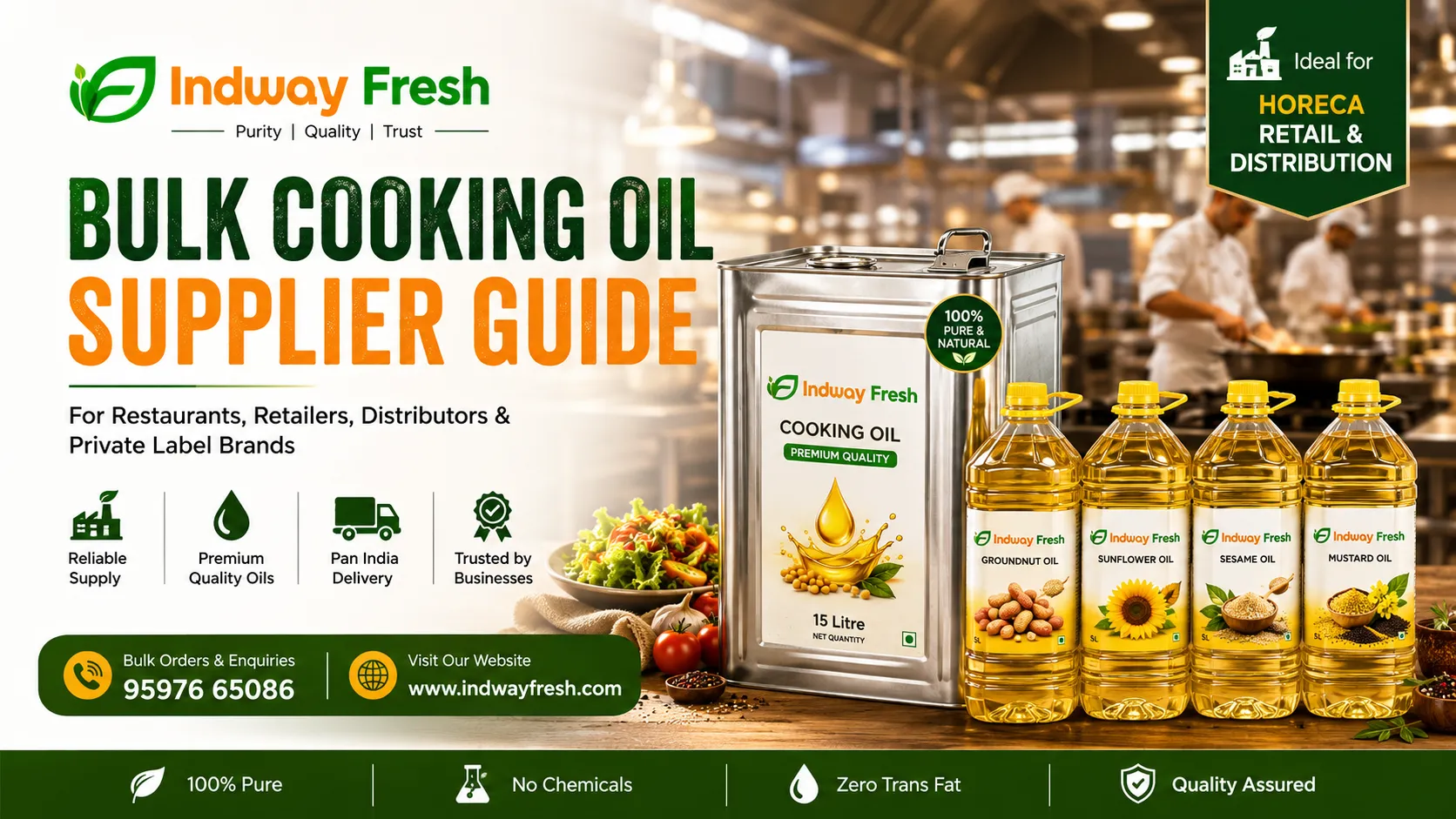
Bulk Cooking Oil Supplier for Restaurants & Cloud Kitchens in India
Restaurants and cloud kitchens run on volume, consistency, and margin — and cooking oil touches all three. It’s one of the most frequently reordered items in any commercial kitchen, and the difference between a reliable bulk supplier and an inconsistent one shows up quickly: in food cost, in frying performance, and in FSSAI compliance during inspection.
This guide covers what restaurant owners and cloud kitchen operators should actually look for when sourcing cooking oil in bulk and where cold-pressed oil fits into that picture.
Why Bulk Sourcing Matters More for Restaurants Than Retail Buyers
A retail household buyer cares about taste and health positioning. A commercial kitchen has additional, non-negotiable concerns:
- Consistency across batches — a shift in oil quality mid-week can throw off frying results and food cost calculations.
- Smoke point and frying stability — oils that break down faster under sustained high heat lead to higher absorption, faster degradation, and more frequent oil changes, all of which quietly inflate costs.
- Regulatory compliance — FSSAI licensing is mandatory for every food business operator in India regardless of size or format, with the licence category (basic registration, State licence, or Central licence) determined by annual turnover.
- Documentation for inspection — restaurants and cloud kitchens are expected to maintain records tied to food safety compliance, and having a supplier who can provide batch-level documentation makes this considerably easier.
What to Look For in a Bulk Cooking Oil Supplier
FSSAI, ISO & HACCP Certification
Sourcing from a supplier without verified FSSAI, ISO, and HACCP certification exposes your kitchen to compliance risk that ultimately falls on you during inspection, not the supplier. Always ask to see current certificates rather than take a printed licence number at face value.
Certificate of Analysis (COA) Per Batch
Serious commercial kitchens should expect batch-level documentation covering Free Fatty Acid (FFA) value and peroxide value (PV) — both are standard indicators of oil quality and freshness, and tracking them over repeat orders is how you catch a supplier’s quality slipping before it shows up in your food.
Packaging Suited to Commercial Volume
Retail bottles don’t make sense at restaurant or cloud kitchen scale. Bulk suppliers typically offer tins (15L/15kg) or drums designed for high-turnover kitchen use, which also reduces per-litre packaging cost compared to buying retail-size bottles in volume.
Supply Consistency & Delivery Reliability
A kitchen running out of oil mid-service isn’t a minor inconvenience — it’s a service disruption. Ask potential suppliers about their standard delivery cycle, minimum order quantity, and how they handle urgent reorders during high-demand periods.
Used Cooking Oil (UCO) Disposal Support
FSSAI regulations require food business operators consuming significant volumes of cooking oil daily to dispose of used oil properly under the RUCO (Repurpose Used Cooking Oil) framework rather than reusing it beyond safe limits or discarding it improperly. Some suppliers can guide kitchens toward compliant UCO collection partners as part of the relationship — worth asking about upfront rather than scrambling to find one after an inspection flag.
Where Cold-Pressed Oil Fits in Commercial Kitchens
Cold-pressed groundnut and coconut oil both carry naturally high smoke points, which makes them genuinely suitable for high-heat applications like deep frying and tawa cooking — not just a health-marketing claim. Because cold-pressed oil is extracted without chemical solvents, it also tends to retain more natural stability across repeated frying cycles when sourced and stored correctly, which matters for kitchens running multiple frying sessions per day.
That said, cold-pressed oil isn’t automatically the right fit for every application — kitchens with very high-volume, continuous frying operations (like large QSR chains) should evaluate oil performance against their specific frying cycle and cost targets rather than switching on health positioning alone. It tends to make the most sense for restaurants, specialty cloud kitchens, and health-forward food brands where the sourcing story is part of the value proposition to the end customer.
Questions to Ask Before Signing a Supply Agreement
- Can you provide FSSAI licence details and current ISO/HACCP certificates?
- Will each batch come with a Certificate of Analysis (FFA, PV values)?
- What’s your minimum order quantity and standard delivery cycle?
- What packaging formats do you offer for commercial volume?
- Do you support or guide UCO disposal compliance?
- What happens if a batch doesn’t meet expected quality — replacement or credit policy?
Sourcing from Indway Fresh
Indway Fresh is a Madurai, Tamil Nadu-based manufacturer of cold-pressed groundnut, gingelly, coconut, sunflower, safflower, and mustard oil, produced using traditional cold-press extraction without chemical solvents. The company holds ISO 9001:2008 and ISO 22000:2005 (Food Safety Management System with HACCP) certification and supports bulk, wholesale, and corporate orders for restaurants, hotels, and food businesses.
[Placeholder — verify before publishing: Indway Fresh’s specific tin/drum packaging sizes for HoReCa buyers, MOQ, delivery cycle, and bulk pricing are not publicly listed and should be confirmed with the team before this section goes live with specifics.]
Sourcing bulk cooking oil for your restaurant or cloud kitchen? Get in touch with Indway Fresh for bulk and corporate enquiries — Madurai, Tamil Nadu. Submit a wholesale enquiry through the Indway Fresh wholesale enquiry form.
Frequently Asked Questions
Is cold-pressed oil suitable for deep frying in a commercial kitchen?
Cold-pressed groundnut and coconut oil both have naturally high smoke points, making them suitable for deep frying and tawa cooking. Performance across repeated frying cycles depends on proper handling and storage, so it’s worth evaluating against your specific frying volume.
What FSSAI licence does a cloud kitchen need?
It depends on annual turnover — basic registration applies below ₹12 lakh, a State FSSAI licence applies between ₹12 lakh and ₹20 crore, and a Central licence applies above that threshold. Every food business operator needs one of these regardless of format.
What documentation should a bulk cooking oil supplier provide?
At minimum, a valid FSSAI licence and, ideally, ISO/HACCP certification, plus a Certificate of Analysis per batch covering FFA and peroxide values so you can track consistency across orders.
Do restaurants need to dispose of used cooking oil in a specific way?
Yes — FSSAI’s RUCO framework requires food business operators consuming significant daily volumes of cooking oil to follow proper disposal or collection practices rather than reusing oil indefinitely or discarding it without compliance.
