

-
Vinoth
- Posted on
- Categories:General
- 0 comments
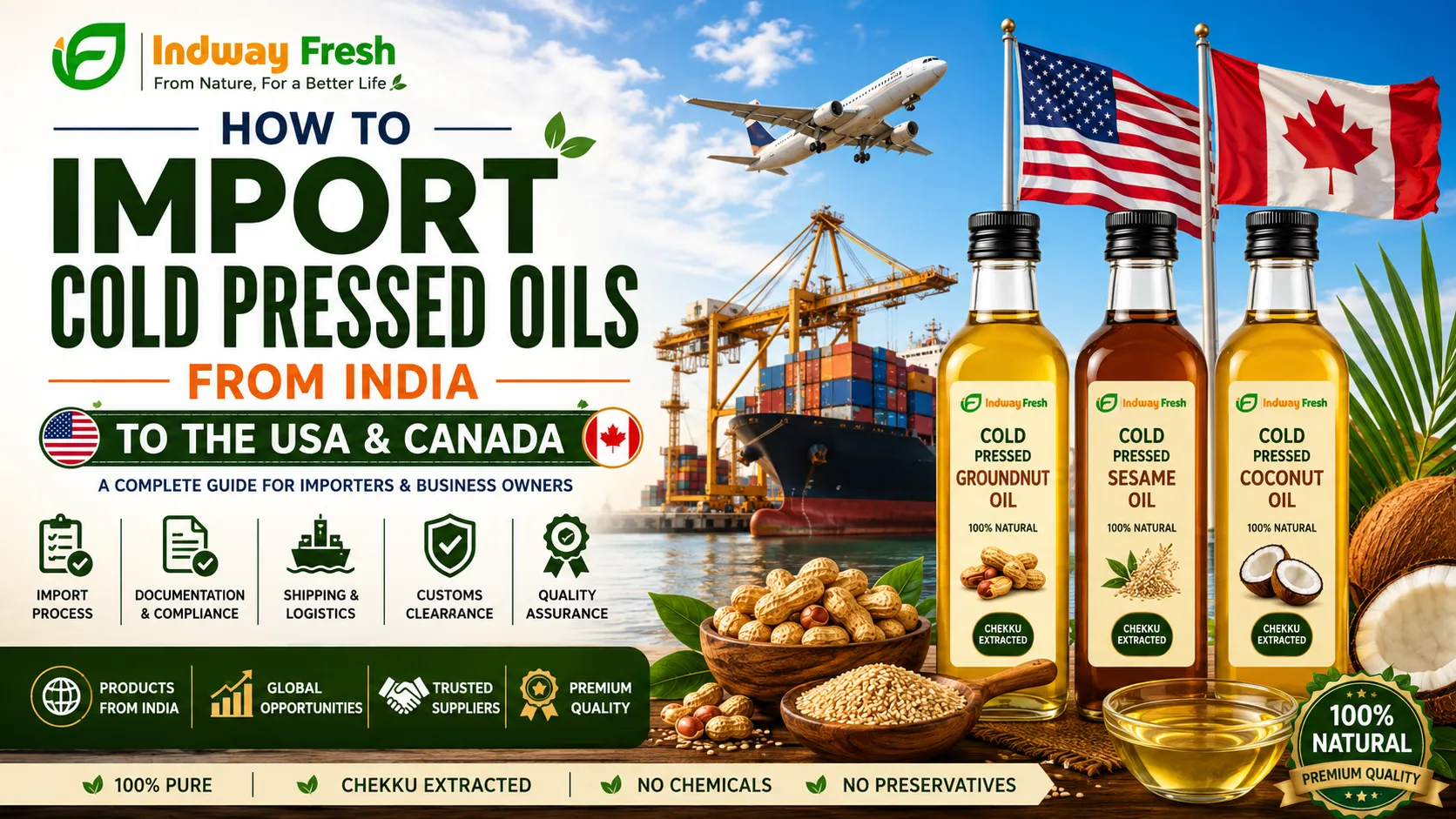
India’s cold-pressed oils — groundnut, gingelly (sesame), coconut, mustard, and sunflower — have found a steady audience among North American buyers looking for chemical-free, minimally processed cooking oils. Indian diaspora households, specialty grocers, and clean-label retailers across the USA and Canada are increasingly sourcing directly from Indian manufacturers rather than settling for what’s on domestic shelves.
The USA and Canada regulate food imports more strictly than most Gulf or Southeast Asian markets, so getting the compliance side right matters more here. This guide breaks down what US and Canadian buyers actually need to check before placing an order and what Indian exporters need to have in place.
Why North American Buyers Are Sourcing Cold-Pressed Oil from India
Cold-pressed oil retains the seed’s natural aroma, color, and nutrient content because it’s extracted without heat or chemical solvents—the opposite of the refined, deodorized vegetable oils that dominate US and Canadian grocery aisles. For diaspora buyers, it’s about authenticity and taste. For the broader clean-label market, it’s about avoiding hexane extraction and additives. Either way, demand has been steadily shifting toward direct import relationships with Indian manufacturers rather than relying on repackaged, mass-market substitutes.
Importing into the USA: What’s Required
FDA Facility Registration
Any Indian manufacturer exporting food products, including edible oils, to the USA must be registered with the FDA under the Bioterrorism Act and FSMA regulations. This registration has to be current and renewed every two years — a lapsed registration will hold up shipments at the port.
Foreign Supplier Verification Program (FSVP)
The FSVP rule requires the US-based importer to verify that the food they’re bringing in meets US safety standards. This responsibility sits with the US importer of record, not the Indian exporter — for FSVP purposes, the importer is the US owner or consignee of the food at the time of entry, or their authorized US agent if there’s no US-based owner. In practice, this means: FDA
- The US importer needs a qualified individual to build and maintain the FSVP file.
- The importer must confirm the food is produced under hazard-analysis and preventive-controls standards equivalent to US requirements, isn’t adulterated, and isn’t misbranded with respect to allergen labeling. FDA
- For cold-pressed oils specifically, unrefined oils like cold-pressed or expeller-pressed peanut oil retain allergenic protein and must declare “peanut” on the label—this exemption only applies to highly refined oils where protein has been removed to below detectable levels, and that has to be backed by data, not assumed. Field registration assistance
HTS Classification & Customs Documentation
Edible oils are classified under specific Harmonized Tariff Schedule (HTS) codes depending on the oil type (groundnut, sesame, coconut, etc.), which determines the duty rate applied at entry. Getting the HTS code wrong is one of the more common reasons shipments get held at customs.
Choosing a Customs Broker
Not every customs broker is equipped to handle FDA-regulated food shipments. Look for a broker with specific experience in FDA Prior Notice filing, facility registration verification, and the correct HTS chapter for edible oils — a broker used to handling general consumer goods can miss details that trigger a hold.
Importing into Canada: What’s Required
Safe Food for Canadians (SFC) Licence
To import most foods into Canada, the Safe Food for Canadians Act and its regulations require the importer to hold a license issued by the Canadian Food Inspection Agency, and this license number must be declared correctly on the import declaration or the shipment gets automatically rejected. Since February 2024, CFIA automatically verifies SFC licences for manufactured food imports at the point of entry—if a valid licence isn’t declared, the transaction is rejected outright. Canadian Food Inspection Agency Canada
This license has to be secured before the shipment arrives. Businesses cannot obtain an SFC license at the border—it needs to be in place beforehand, and the license number has to be entered exactly as issued. Canada Border Services Agency
Preventive Control Plan
If a preventive control plan is required for the commodity, it has to be implemented before applying for the SFC license. This is essentially Canada’s version of a documented food safety management system—having ISO 22000/HACCP certification already in place on the Indian manufacturer’s side makes this significantly easier to satisfy. Canadian Food Inspection Agency
Labelling Compliance
Fat and oil products sold in Canada need to use the correct common name as prescribed under the Canadian Food Compositional Standards, and terms like “cold pressed” and “virgin” have specific regulatory definitions that the labeling must match—misusing these terms is treated as a compliance issue, not just a marketing choice. Inspection Canada
Documentation Checklist for Both Markets
| Document | Required For | Notes |
|---|---|---|
| FDA Facility Registration | USA | Must be renewed every 2 years |
| FSVP Records | USA | Held by the US importer, not the Indian exporter |
| Correct HTS Code | USA | Determines duty rate; errors cause customs holds |
| SFC Licence | Canada | Held by the Canadian importer; must predate shipment arrival |
| Preventive Control Plan | Canada | Required before SFC licence application, where applicable |
| FSSAI Licence | Both | Base requirement for any Indian food export |
| IEC (Import Export Code) | Both | Required for the Indian exporting entity |
| Certificate of Origin | Both | Confirms Indian origin for customs clearance |
| Commercial Invoice & Packing List | Both | Standard customs documentation |
| Lab Test Reports | Both | Moisture, FFA levels, contaminants; strengthens FSVP/preventive control compliance |
A Note on Responsibility
Both the US and Canadian systems place the compliance burden primarily on the importer inside the country, not the Indian exporter. That doesn’t mean the exporter’s side doesn’t matter — a US or Canadian importer can only build a compliant FSVP file or preventive control plan if the Indian manufacturer provides accurate certifications, lab reports, and process documentation. Buyers should treat a supplier’s willingness to share this paperwork upfront as a basic filter, not an extra ask.
Sourcing from Indway Fresh
Indway Fresh is a Madurai, Tamil Nadu-based manufacturer of cold-pressed groundnut, gingelly, coconut, sunflower, safflower, and mustard oil, produced without chemical solvents. The company holds ISO 9001:2008 and ISO 22000:2005 (Food Safety Management System with HACCP) certification, which supports the documentation a US or Canadian importer needs for FSVP and preventive control compliance.
Sourcing cold-pressed oil for the USA or Canada?
Get in touch with Indway Fresh for bulk and private-label enquiries — Madurai, Tamil Nadu. Submit a wholesale enquiry through the Indway Fresh wholesale enquiry form.
Frequently Asked Questions
Does the Indian exporter need US or Canadian certification, or just FSSAI?
FSSAI is the baseline requirement on the Indian side. But the heavier compliance burden — FSVP in the USA, SFC licensing in Canada—sits with the importer inside those countries. The Indian exporter’s job is to supply accurate documentation (lab reports, process details, certifications) that the importer needs to build their own compliance file.
Can a cold-pressed peanut oil be sold without allergen labelling in the USA?
No, unless the oil has been highly refined to the point where allergenic protein is removed to below detectable levels, backed by data. Cold-pressed and expeller-pressed peanut oil retains protein and must declare peanut on the label. Fdaregistrationassistance
Can I get an SFC licence at the Canadian border if I don’t have one yet?
No — the SFC licence must be obtained before the shipment is presented at the border; it cannot be issued at the point of entry. Canada Border Services Agency
What’s the biggest reason cold-pressed oil shipments get held at US customs?
Usually a misclassified HTS code, missing or lapsed FDA facility registration, or a supplier who can’t provide the documentation the US importer needs for their FSVP file.
