

-
Vinoth
- Posted on
- Categories:General
- 0 comments
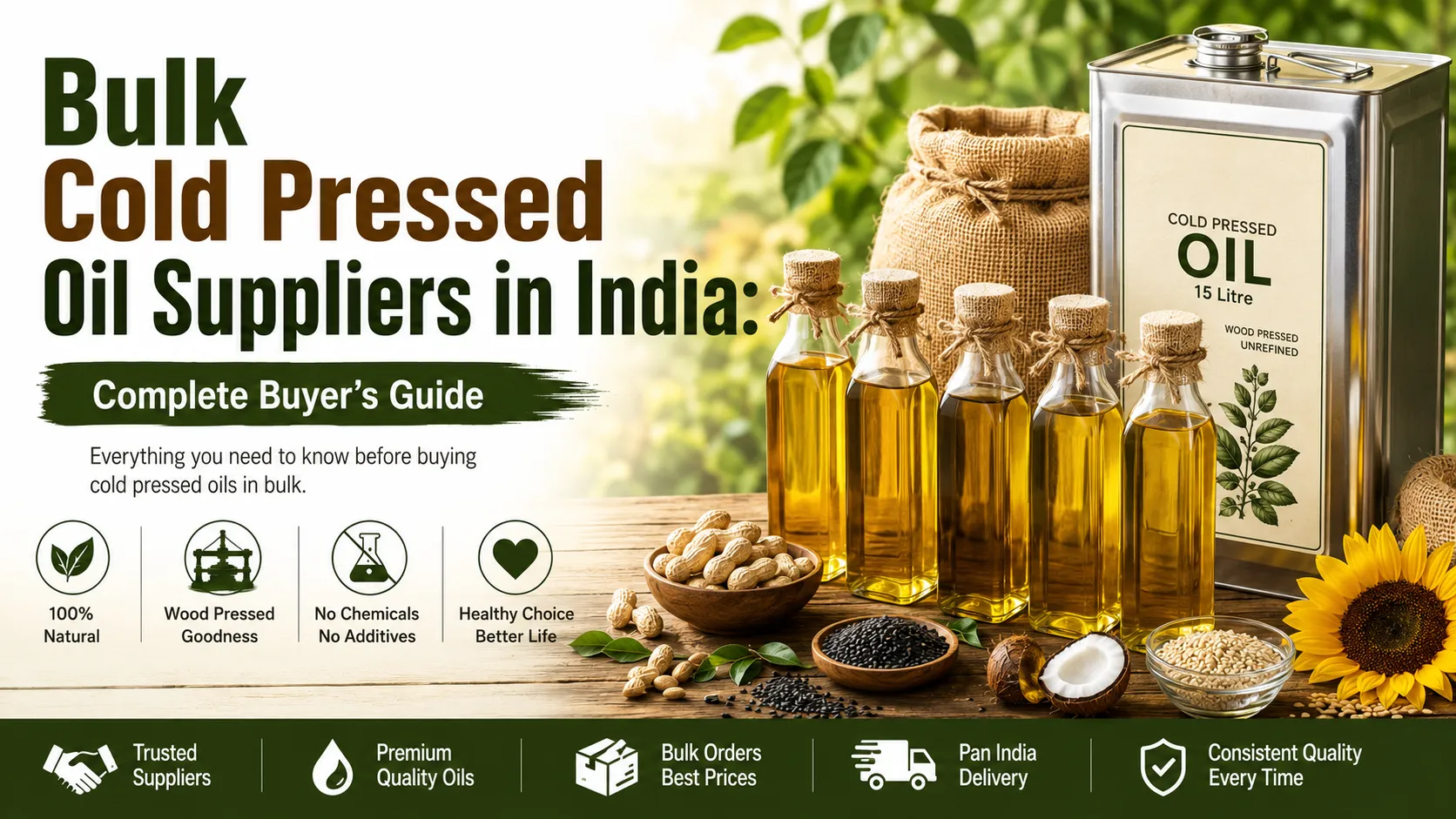
If you’re building a food brand, running a cloud kitchen chain, supplying a hotel group, or launching a D2C cold pressed oil line, sourcing directly from a bulk supplier is the single biggest lever on your margins. The difference between buying retail-packed bottles and sourcing from a manufacturer at wholesale rates can be 30-50% on landed cost — but only if you know how to vet a supplier properly.
This guide breaks down exactly how the bulk cold pressed oil supply chain in India works: who the suppliers are, what you should expect to pay, which certifications actually matter, and the red flags that separate a reliable manufacturing partner from a reseller repacking someone else’s oil.
- 1. Who Actually Supplies Bulk Cold-Pressed Oil in India
The bulk cold-pressed oil market in India is fragmented across four supplier categories, and it matters which one you’re dealing with:
- Traditional ghani/chekku manufacturers—small to mid-sized units, often family-run, using wood or stone cold press (ghani) technology. Common in Tamil Nadu, Karnataka, and parts of Andhra Pradesh. Strong on authenticity and traditional extraction, variable on packaging and documentation.
- Organized cold-press manufacturers — larger operations with FSSAI licensing, lab testing, and B2B sales teams built specifically for bulk and private-label orders. This is the segment most D2C brands and food businesses should target.
- B2B marketplaces and directories (IndiaMART, TradeIndia, ExportersIndia, Volza) — aggregators, not suppliers themselves. Useful for discovery and price benchmarking, but every listing needs independent verification.
- Traders and repackers — buy oil in bulk from manufacturers and resell it, sometimes blended or relabeled. Not inherently bad, but you lose traceability to the actual pressing unit, which matters for quality claims on your packaging.
For a food brand or D2C business, going directly to an organized manufacturer (or a serious traditional ghani unit that has scaled up its compliance) is almost always the better long-term move than sourcing through a trader.
2. Types of Cold Pressed Oils Available at Wholesale
Most Indian manufacturers offer some combination of the following in bulk:
| Oil Type | Common Bulk Uses |
|---|---|
| Groundnut (peanut) oil | Cooking, frying, D2C retail packs |
| Sesame (gingelly/til) oil | Cooking, traditional/ayurvedic use, hair & skin care lines |
| Coconut oil (virgin/cold-pressed) | Cooking, cosmetics, hair care, D2C wellness brands |
| Mustard (kachi ghani) oil | North Indian cooking, pickling |
| Sunflower oil | General cooking, HoReCa |
| Almond, castor, neem oils | Skincare/haircare formulations, smaller volume, higher margin |
If your business spans both food and personal care, many manufacturers will quote combined MOQs across categories — worth negotiating if you’re building a multi-SKU brand.
3. Regional Sourcing Hubs
- Tamil Nadu (Madurai, Coimbatore, Tiruppur, Salem) — the strongest cluster for traditional wood-pressed (marachekku) sesame and groundnut oil, with a growing number of FSSAI-licensed units built specifically for B2B and private label supply.
- Karnataka (Bengaluru, Mysuru) — coconut and groundnut oil, strong export infrastructure.
- Maharashtra (Pune, Nashik) — groundnut and sunflower, good connectivity to west coast ports for export-oriented buyers.
- Rajasthan (Jaipur) — mustard oil hub, kachi ghani specialists.
- Kerala — virgin coconut oil, particularly for cosmetics and wellness brands.
If you’re sourcing for a business based in Tamil Nadu, Madurai-based manufacturers offer a practical advantage: shorter lead times, easier factory visits, and lower inbound freight if you’re distributing regionally before scaling pan-India.
4. Bulk Pricing: What to Expect (INR per Litre)
Prices swing with seasonal seed costs, so treat these as directional ranges rather than fixed quotes — always get a current rate card before budgeting.
| Oil | Approx. Bulk Rate (₹/litre) | Notes |
|---|---|---|
| Groundnut (cold-pressed) | ₹180 – ₹260 | Varies with groundnut seed season |
| Sesame/Gingelly (cold pressed) | ₹280 – ₹420 | Premium over groundnut; wood-pressed commands a further premium |
| Coconut (virgin cold pressed) | ₹220 – ₹350 | Kerala/Tamil Nadu sourcing typically cheaper than branded retail |
| Mustard (kachi ghani) | ₹150 – ₹220 | Rajasthan/UP sourcing generally most competitive |
| Sunflower (cold pressed) | ₹160 – ₹230 | Least premium-priced of the common oils |
Suppliers typically offer tiered discounts — a noticeably better rate at 500L+ and again at 2,000L+ or full tanker-load quantities. Always ask for the tier breakdown rather than a single flat quote; it tells you a lot about how negotiable the supplier actually is.
5. MOQs and Order Structures
- Entry-level bulk MOQs: Many manufacturers accept 50-200 liters for a first order, especially for private-label testing.
- Standard wholesale MOQs: 500-1,000 litres per SKU is common once you move past the trial order.
- Tanker/full-load orders: 5,000+ liters for large HoReCa chains or FMCG-scale buyers, usually with the steepest per-liter discount.
- Payment terms: expect advance payment for your first few orders (a common practice while trust is being established), shifting to partial advance + balance on delivery, or credit terms once you have an order history with the supplier.
If you’re testing product-market fit before committing to a large SKU run, negotiate a smaller trial MOQ explicitly — most manufacturers will accommodate this for a first-time B2B buyer even if it’s not advertised.
6. Certifications That Actually Matter
Not every certification on a supplier’s website carries equal weight. Prioritize in this order:
- FSSAI License (State or Central) — non-negotiable. Every legitimate manufacturer, wholesaler, or distributor of edible oil in India must hold this. Ask for the 14-digit license number and verify it on the FoSCoS portal (foscos.fssai.gov.in). Manufacturers of edible oil are additionally required to maintain in-house or NABL-accredited lab testing facilities for parameters like free fatty acid content, peroxide value, and moisture.
- GST registration — confirms it’s a legitimate registered business, important for your own input tax credit if applicable.
- Agmark certification — a quality mark under the Agricultural Produce (Grading & Marking) Act, useful but not mandatory; a positive signal on a supplier profile.
- ISO 22000 / HACCP — more common with larger, export-oriented manufacturers; a strong signal if you’re planning to scale into modern trade or export.
- Organic certification (India Organic/NPOP, USDA Organic) — only relevant if you’re marketing an organic claim; don’t pay a premium for it if your positioning doesn’t need it.
A supplier who can’t produce their FSSAI number on request, or whose number doesn’t verify on FoSCoS, should be an immediate pause point regardless of how good their pricing looks.
7. Supplier Evaluation Checklist
Before finalizing any bulk cold pressed oil supplier, work through this:
- [ ] FSSAI license number verified on FoSCoS
- [ ] GST number verified
- [ ] Factory/pressing unit location confirmed — ideally with a video call or in-person visit before a large order
- [ ] Sample batch tested (send to a third-party or your own quality check before bulk commitment)
- [ ] Clear rate card across order-size tiers, not just a single quoted price
- [ ] Written MOQ, payment terms, and delivery timeline
- [ ] Packaging options confirmed (bulk drums vs. ready-to-label bottles)
- [ ] Labeling/private-label capability confirmed if relevant to your business
- [ ] References or existing B2B clients you can check with
- [ ] Return/replacement policy for a batch that fails your quality check
Treat the first order as a trial regardless of how established the supplier appears—consistency across batches is the real test, not a single sample.
8. Private Labeling and Custom Packaging
Most organized manufacturers now offer private-label programs for D2C and food service brands, typically including
- Custom bottle sizes (200ml to 15L, sometimes up to bulk drums/tankers)
- Label printing and application under your brand
- Combo pack assembly (e.g., multi-oil gift sets or cooking + haircare combos)
- Minimum order thresholds that are usually higher than a plain-bulk order, since packaging changeover adds cost
If private labeling is part of your plan, ask upfront whether the manufacturer handles label compliance (FSSAI-mandated labeling fields—batch number, manufacturing date, best-before date, FSSAI number, nutritional info) or whether that responsibility sits with you. Getting this wrong is one of the most common compliance gaps for new D2C oil brands.
9. Logistics, Packaging Formats, and Shelf Life
- Bulk packaging formats: HDPE drums (15 L, 20 L, 35 L), jerry cans, and for very large orders, food-grade tankers.
- Typical shelf life: cold pressed oils generally hold 6-12 months unopened when stored in cool, dark conditions — shorter than refined oils since they retain more natural compounds and lack the stabilizing effect of refining.
- Delivery timelines: regional delivery (within-state) typically runs 2-5 days; pan-India delivery for bulk orders commonly takes 5-10 days depending on the destination and transporter.
- Freight cost: often quoted separately from the oil price for bulk orders—always ask whether your quote is ex-factory or delivered, since this materially changes the effective per-liter cost.
10. Red Flags: Signs of Adulteration or an Unreliable Supplier
- Reluctance to share FSSAI license details or lab test reports
- Pricing significantly below the market range for that oil and season — often a sign of blending with cheaper refined oil
- No physical factory address, or an address that doesn’t correspond to an actual pressing facility
- Inconsistent oil color, smell, or texture across “sample” and “bulk” batches
- No written terms — everything communicated only over phone/WhatsApp with no documentation
- Pressure to pay full advance before any sample verification
FSSAI runs periodic anti-adulteration drives specifically targeting edible oil, and common adulteration practices include blending with cheaper oils or, in rarer, serious cases, mineral oil—all the more reason to insist on lab-tested samples before scaling an order.
11. Manufacturer Spotlight: Standard Cold Pressed Oil, Madurai
Based in Madurai, Tamil Nadu, Standard Cold Pressed Oil is a manufacturer and wholesale supplier positioned for both bulk B2B orders and private-label partnerships. Key points relevant to buyers evaluating them:
- Product range: groundnut, sesame, coconut, and neem cold-pressed oils, with groundnut oil available from 200 ml retail packs up to 15-liter bulk containers.
- Order flexibility: caters to both large bulk orders and smaller trial quantities, with a stated focus on transparent, tiered wholesale pricing.
- Delivery: nationwide delivery, with stated timelines around 5-7 days to Delhi from their Tamil Nadu base — a useful benchmark for estimating lead times to other regions.
- Payment terms: advance payment is generally required for a buyer’s first few orders, shifting toward more flexible terms as a trading relationship builds — a fairly standard structure across the traditional cold-press manufacturing segment.
- Presence: actively serving wholesale buyers across South Indian metros, including Chennai, Coimbatore, Bengaluru, and Hyderabad, in addition to Tamil Nadu.
As with any manufacturer, treat this as a starting point for due diligence rather than a substitute for it—verify current FSSAI status, request a current rate card, and run a sample batch through your own quality check before committing to a bulk order.
12. FAQs
What’s a realistic MOQ to start with as a new D2C brand? Most manufacturers will accommodate 50-200 liters for a first trial order, even if their standard wholesale MOQ is higher—it’s usually worth asking directly rather than assuming the advertised MOQ is fixed.
Is wood-pressed (marachekku) oil worth the price premium over standard cold-pressed? It commands a premium mainly due to slower extraction and lower yield per hour, not because of a fundamentally different nutrient profile. Worth it if your brand positioning leans on traditional/heritage extraction methods; less relevant if you’re competing primarily on price.
How do I verify a supplier’s FSSAI license is real? Search the license number on the FoSCoS portal (foscos.fssai.gov.in) — it will show the license status, category, and validity.
Should I buy directly from a manufacturer or through a B2B marketplace like IndiaMART? Marketplaces are useful for discovery and initial price benchmarking, but always move to direct communication and independent verification (FSSAI check, sample testing, and factory confirmation) before placing a bulk order—the marketplace listing itself isn’t a guarantee of quality or legitimacy.
What’s the biggest cost lever in bulk cold pressed oil sourcing? Order volume tier and freight terms (ex-factory vs. delivered) typically move the effective per-liter cost more than any other single factor—always compare quotes on a like-for-like basis.
.
