

-
Vinoth
- Posted on
- Categories:General
- 0 comments
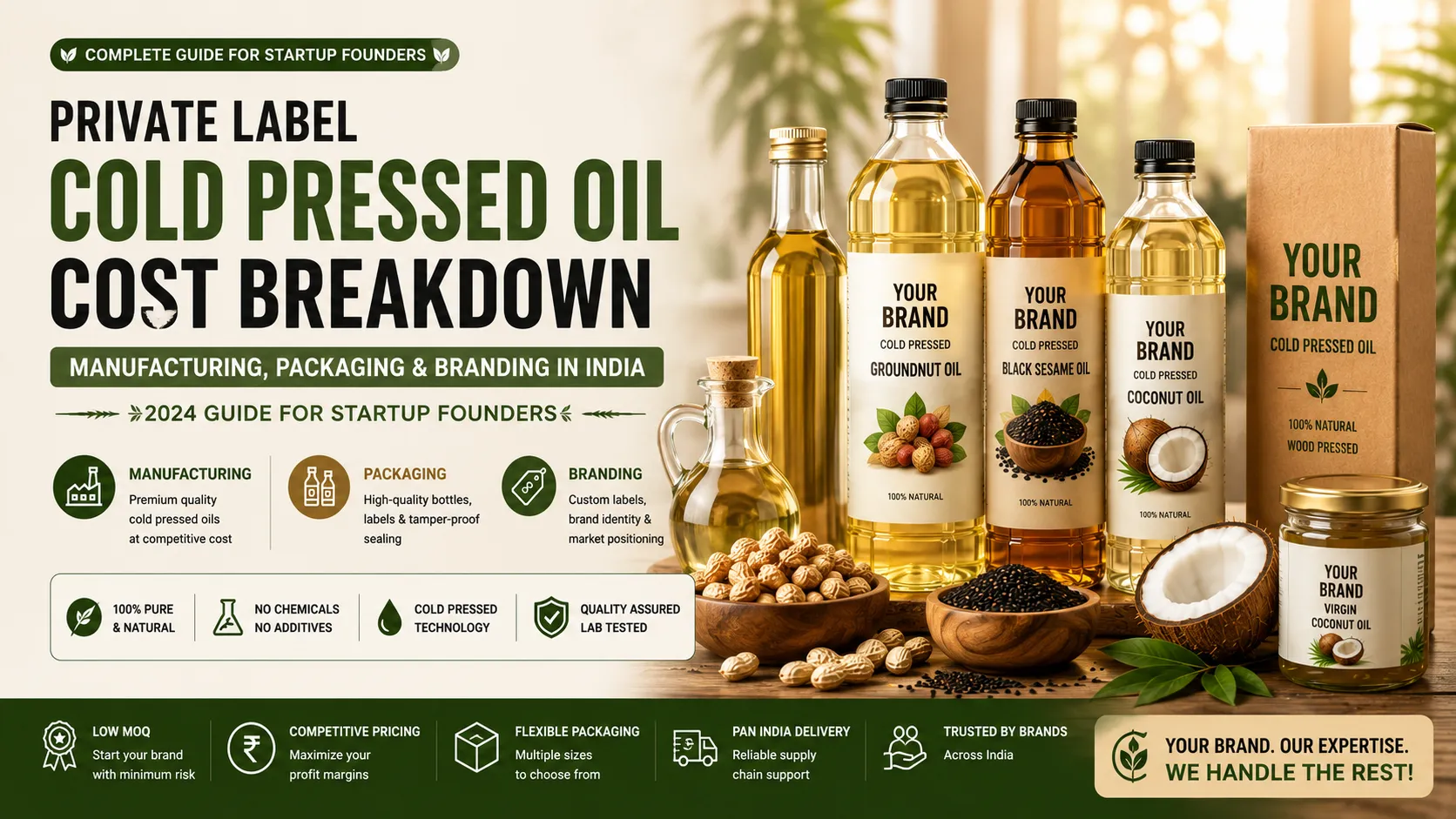
Why Cold Pressed Oils Are the Next Big D2C Opportunity in India
India’s cold-pressed oil market is projected to grow at a CAGR of over 8% through 2028, driven by a health-conscious urban consumer base that’s actively moving away from refined oils. For startup founders, this creates a compelling window — and the private label route offers the fastest path to market without building a manufacturing facility from scratch.
But before you commit your seed money, you need a clear-eyed picture of what it actually costs to launch a private label cold-pressed oil brand in India. This guide breaks down every major cost category: manufacturing, packaging, branding, compliance, and margins—so you can build a realistic business case.
What Is Private Label Cold Pressed Oil?
“Private label” means you partner with an existing manufacturer (often called a co-manufacturer or contract manufacturer) who produces the oil, and you sell it under your own brand name and packaging. You own the brand; they own the machines.
This model gives you:
- Faster time to market (typically 6–14 weeks vs. 18–24 months to build a plant)
- Lower capital expenditure upfront
- Flexibility to test multiple SKUs before scaling
- Freedom to focus on marketing, distribution, and brand building
The trade-off: lower control over the production process, minimum order quantities (MOQs), and margin sharing.
The Full Private Label Oil Cost India Breakdown
Here’s the honest picture, broken down by stage.
1. Raw Material Cost
This is the single largest variable in your cost structure, and it depends heavily on which oil you’re producing.
Cold-Pressed Oil Raw Material Cost Ranges (per litre of finished oil)
| Oil Type | Raw Material Cost (₹/litre) | Yield Ratio | Notes |
|---|---|---|---|
| Groundnut (Peanut) | ₹80–110 | ~35–38% | Most common, good margins |
| Coconut | ₹90–130 | ~30–35% | Premium positioning easier |
| Sesame (Gingelly) | ₹130–180 | ~42–45% | High demand in South India |
| Mustard | ₹70–100 | ~32–36% | Large North India market |
| Sunflower | ₹80–115 | ~38–42% | Competitive category |
| Flaxseed (Linseed) | ₹160–220 | ~35–38% | Niche, high price point |
| Castor | ₹60–90 | ~45–50% | Industrial + therapeutic use |
| Black Seed (Kalonji) | ₹250–350 | ~28–32% | Ultra-premium segment |
Key insight for founders: The yield ratio matters enormously. For coconut oil, you need roughly 3 kg of copra to produce 1 litre of oil. Every rupee increase in copra prices directly compresses your margin. Lock in supplier agreements early.
Seasonal price volatility is real — groundnut prices can swing 20–35% between monsoon and summer. Factor this into your pricing strategy
2. Manufacturing / Contract Processing Cost
Cold pressing is a mechanical extraction process using a wooden churner (Ghani/Kolhu) or modern expeller press run at low temperatures (below 45°C) without chemicals or heat treatment. This is what preserves nutrients and commands the price premium.
3. Packaging Cost
Packaging is where startup founders consistently underestimate costs — and where your brand is either made or broken at the shelf or on the customer’s kitchen counter.
Bottle Options and Cost Ranges
| Packaging Type | Unit Cost (₹) | Notes |
|---|---|---|
| PET bottle (500 ml) | ₹6–12 | Budget tier, not ideal for premium positioning |
| HDPE bottle (500 ml) | ₹8–15 | Better barrier properties, mid-tier |
| Glass bottle (250 ml) | ₹22–40 | Premium, heavier, breakage risk in logistics |
| Glass bottle (500 ml) | ₹35–65 | Best premium positioning |
| Tin/aluminium can (500 ml) | ₹28–50 | Heritage/artisanal feel, good light barrier |
| Flexible pouch (1 litre) | ₹10–18 | Lower price segment, high refill appeal |
Additional Packaging Components
| Component | Unit Cost (₹) |
|---|---|
| Cap/closure (induction seal) | ₹2–5 |
| Label (front + back, paper) | ₹3–8 |
| Label (BOPP/premium finish) | ₹6–14 |
| Carton box (per 12-bottle master carton) | ₹35–70 |
| Tamper-evident seal/shrink wrap | ₹1–3 |
| QR code + batch printing | ₹0.50–1.50 |
MOQ for packaging: Label printers typically require 1,000–2,000 units minimum. Glass bottle manufacturers have MOQs of 500–1,000 units per SKU. For early-stage brands, buying off-the-shelf standard bottle shapes and doing custom labels is the smartest cost-efficient approach.
Founder tip: Don’t underestimate logistics damage for glass. Budget 2–4% breakage in your unit economics for D2C glass bottle SKUs.
4. Branding & Design Cost
This is a one-time cost that gets amortised across your lifetime of sales, but it’s non-negotiable if you want to compete in the ₹350–800/litre premium segment.
Branding Investment Breakdown
| Deliverable | Freelancer (₹) | Mid-tier Agency (₹) | Premium Agency (₹) |
|---|---|---|---|
| Brand name + logo | 8,000–20,000 | 25,000–60,000 | 80,000–2,00,000 |
| Label design (2 SKUs) | 5,000–15,000 | 20,000–50,000 | 60,000–1,50,000 |
| Brand guidelines | 3,000–10,000 | 15,000–35,000 | 40,000–1,00,000 |
| Product photography | 8,000–20,000 | 25,000–60,000 | 70,000–2,00,000 |
| Website (basic D2C) | 15,000–40,000 | 50,000–1,50,000 | 2,00,000–6,00,000 |
| Social media templates | 5,000–12,000 | 15,000–30,000 | 40,000–80,000 |
| Total Branding | ₹44,000–1,17,000 | ₹1,50,000–3,85,000 | ₹4,90,000–13,30,000 |
The smart play for bootstrapped founders: Use platforms like Fiverr, Dribbble, or DesignCrowd for your initial label design. Invest in quality product photography — it’s the highest ROI spend in the D2C channel. Budget ₹50,000–1,00,000 total for branding at the launch stage.
5. Compliance & Certification Costs
This is non-negotiable and often the most underestimated category by first-time food founders.
Mandatory Compliance
| Requirement | Cost (₹) | Timeframe |
|---|---|---|
| FSSAI Basic Registration (turnover < ₹12L) | ₹100/year | 7–30 days |
| FSSAI State License (turnover ₹12L–20Cr) | ₹2,000–5,000/year | 30–60 days |
| FSSAI Central License (turnover > ₹20Cr or online/multi-state) | ₹7,500/year | 30–60 days |
| GST Registration | Free | 7–14 days |
| Legal Metrology (weights & measures approval) | ₹1,000–5,000 | 15–30 days |
Quality Testing (per batch, NABL-accredited lab)
| Test | Cost (₹) |
|---|---|
| Acid value, peroxide value, FFA | ₹800–1,500 |
| Heavy metals panel | ₹2,000–4,000 |
| Pesticide residue | ₹3,000–6,000 |
| Full nutritional panel | ₹2,500–5,000 |
Optional but high-ROI certifications
| Certification | Cost (₹) | Value |
|---|---|---|
| Organic (NPOP/NOP via accredited certifier) | ₹15,000–60,000/year | +30–60% price premium |
| Vegan certification | ₹8,000–20,000 | Trust signal |
| Non-GMO claim verification | ₹5,000–15,000 | Growing demand |
| Kosher/Halal | ₹20,000–80,000 | Export/community markets |
Budget ₹25,000–75,000 for your first year of compliance, not including optional certifications.
6. Logistics & Fulfillment Cost
For D2C brands, this is the silent margin killer.
Outbound Shipping (per order, metro cities)
| Weight | Surface/Courier (₹) | Express (₹) |
|---|---|---|
| 500g (1 bottle 250 ml) | ₹60–90 | ₹90–130 |
| 1 kg (1 bottle 500 ml) | ₹75–110 | ₹110–160 |
| 2 kg (gift box / combo) | ₹110–160 | ₹150–220 |
| To Tier 2/3 cities | +₹20–40 premium | +₹30–60 premium |
If using 3PL fulfillment centers:
- Inbound receiving: ₹2–5 per unit
- Storage: ₹8–15 per cubic foot per month
- Pick & pack: ₹25–45 per order
- Returns processing: ₹40–80 per return
Budget ₹90–180 per order for total logistics cost (packing + shipping) for a typical 500 ml D2C order in India.
7. Marketing & Customer Acquisition Cost (CAC)
This varies wildly by channel but here are realistic early-stage benchmarks:
| Channel | Estimated CAC (₹) | Notes |
|---|---|---|
| Instagram/Facebook Ads | ₹300–700 | ROAS of 2–4x is achievable with good creative |
| Google Shopping Ads | ₹250–600 | High intent, works well |
| Influencer (nano/micro) | ₹150–400 | Best ROI for health/wellness |
| Marketplace (Amazon, Flipkart) | ₹0 CAC, but 25–35% platform fees | Organic ranking takes time |
| WhatsApp/email retention | ₹30–80 | Highest ROI channel |
Where to find contract manufacturers in India:
Who They Are
Standard Cold Pressed Oil is a manufacturing company based in Madurai, Tamil Nadu, operating under the KaaRas Group — a family that has been in the chekku oil business for three generations since 1971. Founded in 2016 as a modern venture, they have their own in-house labs to test each batch for purity and consistency. Chekku Oil
They are an FSSAI-registered company operating as manufacturer, wholesaler, and retailer of cold pressed oils, dealing with PAN India customers. They provide lab certificates and other clearances with every order. Chekku Oil
Oils They Manufacture
They use the Ghani method to extract oil from groundnut, coconut, sesame seeds, mustard seeds, castor seeds, neem seeds, and mahua seeds — without chemical or solvent extraction, preserving the aroma, flavour, and nutritional characteristics. Chekku Oil
Private Label & Wholesale Capability
Based on client demand, they deliver products in specified packing material and support third-party export agencies in India who deal with regular export activity. They mostly deal through Tuticorin port and have delivered goods to Bahrain and Malaysia. Chekku Oil
Delivery Reach
They offer bulk orders for businesses and retailers with nationwide delivery—2–3 days anywhere in Tamil Nadu, 3–5 days in Karnataka, 4–6 days in Kerala, AP & Telangana, and 8–10 days anywhere in North India. Chekku Oil
Why They’re Worth Contacting as a Startup
- 3-generation heritage in chekku oil — process credibility
- In-house lab testing — you get documentation with every batch
- FSSAI certified — compliance box already ticked
- Willing to do custom packing — private label friendly
- Export experience — if you plan to go international
How to Approach Them
Standard Cold Pressed Oil — Contract Manufacturer Profile
Website: standardcoldpressedoil.com
Phone: 9597665086
Location: Madurai, Tamil Nadu
- Minimum order quantity (MOQ) for private label batches
- Whether they can produce under your brand label
- Lab certificate format (for FSSAI and marketplace listings)
- Lead time per batch
- Price list for bulk/wholesale per litre by oil type
Full Unit Economics Model: What Does One Bottle Actually Cost?
Let’s build a real example: a 500 ml cold pressed groundnut oil bottle, positioned as a premium D2C SKU at ₹450 MRP.
| Cost Head | Amount (₹) |
|---|---|
| Raw material (groundnut) | 95 |
| Manufacturing/processing | 38 |
| Bottle (glass 500 ml) | 48 |
| Cap + label + induction seal | 14 |
| Batch quality testing (amortised) | 6 |
| FSSAI/compliance (amortised) | 3 |
| Packaging (inner + outer box) | 10 |
| Total COGS (Cost of Goods Sold) | ₹214 |
| Logistics (pick + pack + shipping, D2C) | 130 |
| Payment gateway fee (2%) | 9 |
| Marketing/CAC (amortised) | 80 |
| Total Delivered Cost | ₹433 |
| MRP | ₹450 |
| Gross Margin (pre-CAC) | ₹106 (23.5%) |
| Net Contribution (post-CAC) | ₹17 (3.8%) |
What this tells you: At ₹450 MRP with D2C unit economics, the margins are tight unless you reduce CAC through retention (repeat purchases) or increase Average Order Value (AOV) through bundling. This is exactly why most cold pressed oil brands sell bundles (e.g., “3-bottle pack”) and subscription models — the contribution margin on order 2 and beyond jumps dramatically when CAC drops.
At ₹650 MRP (premium segment): Contribution margin improves to ₹140–180 per bottle post-logistics, making the economics far more attractive.
Initial Capital Requirement to Launch
Here’s a realistic startup capital estimate for a 2-SKU cold pressed oil D2C brand:
| Category | Conservative (₹) | Recommended (₹) |
|---|---|---|
| First production batch (500 litres × 2 SKUs) | 1,20,000 | 2,40,000 |
| Packaging (1,000 units × 2 SKUs) | 70,000 | 1,20,000 |
| Branding + design | 50,000 | 1,00,000 |
| Website + D2C setup | 25,000 | 60,000 |
| Compliance + testing | 25,000 | 50,000 |
| Initial marketing budget | 50,000 | 1,50,000 |
| Working capital buffer | 30,000 | 80,000 |
| Total Estimated Launch Capital | ₹3,70,000 | ₹8,00,000 |
A lean launch is possible in ₹3–4 lakhs. A well-capitalised launch that can scale quickly needs ₹7–10 lakhs.
5 Cost Reduction Strategies for Bootstrapped Founders
1. Start with PET, switch to glass at scale. Premium glass drives better ASP, but PET lets you validate demand without the breakage risk and higher per-unit cost. Migrate to glass for your “hero” SKU once you have repeat purchasers.
2. Negotiate co-manufacturing on a revenue-share model. Many small Ghani operators in Tier 2 cities are open to arrangements where they get a guaranteed volume commitment in exchange for lower processing rates.
3. Source packaging regionally. Buying bottles from a manufacturer in the same state as your co-manufacturer cuts 2-way freight costs significantly.
4. Batch your lab testing. Testing every production batch is important, but you can reduce testing frequency once you’ve established consistency with a trusted supplier — move from every batch to every third batch for certain parameters after the first 6 months.
5. Use a shared kitchen/food incubator. Facilities like Kitchens@, Otipy’s network, and various state government food parks offer shared compliant facilities, which can reduce your fixed compliance and infrastructure overhead in year one.
Frequently Asked Questions
What is the minimum investment to start a private label oil brand in India? A realistic minimum is ₹3–4 lakhs for a very lean 1-SKU launch targeting local markets. For a D2C brand with national reach, plan for ₹7–10 lakhs minimum.
How long does it take to get FSSAI approval for a food business? FSSAI basic registration typically takes 7–30 days online. State and central licenses take 30–60 days. Apply before you place your first production order.
What margin should I target for a private label cold pressed oil brand? Target a minimum 40–50% gross margin on MRP (before logistics and marketing) to have a sustainable D2C business. This typically means pricing at 2.5–3x your COGS.
Can I sell on Amazon and Flipkart as a private label oil brand? Yes. You’ll need GST registration, FSSAI license, and to comply with their category listing requirements. Marketplace fees (including fulfillment) run 25–38% of selling price, so price accordingly.
Is organic certification worth it for cold pressed oils? If you can source certified organic raw material and have the budget (₹15,000–60,000/year for certification), organic positioning allows you to price 30–60% higher and tap into a growing premium consumer segment. It’s worth it at scale; skip it in year one if you’re capital-constrained.
Conclusion: Know Your Numbers Before You Press Go
The private label cold pressed oil market in India is real, growing, and accessible — but it rewards founders who do the financial homework before they fall in love with a brand name. Your COGS, logistics stack, and CAC strategy will determine whether you build a business or a very expensive hobby.
The founders who win in this category are the ones who:
- Build tight supplier relationships for raw materials early
- Price for margin, not just market share
- Invest in retention (subscriptions, bundles, loyalty) to drive CAC down over time
- Start with 1–2 SKUs and go deep before going wide
Use this breakdown as your starting point. Build your own model, stress-test it with real supplier quotes, and don’t skip the FSSAI step.
