

-
Vinoth
- Posted on
- Categories:General
- 0 comments
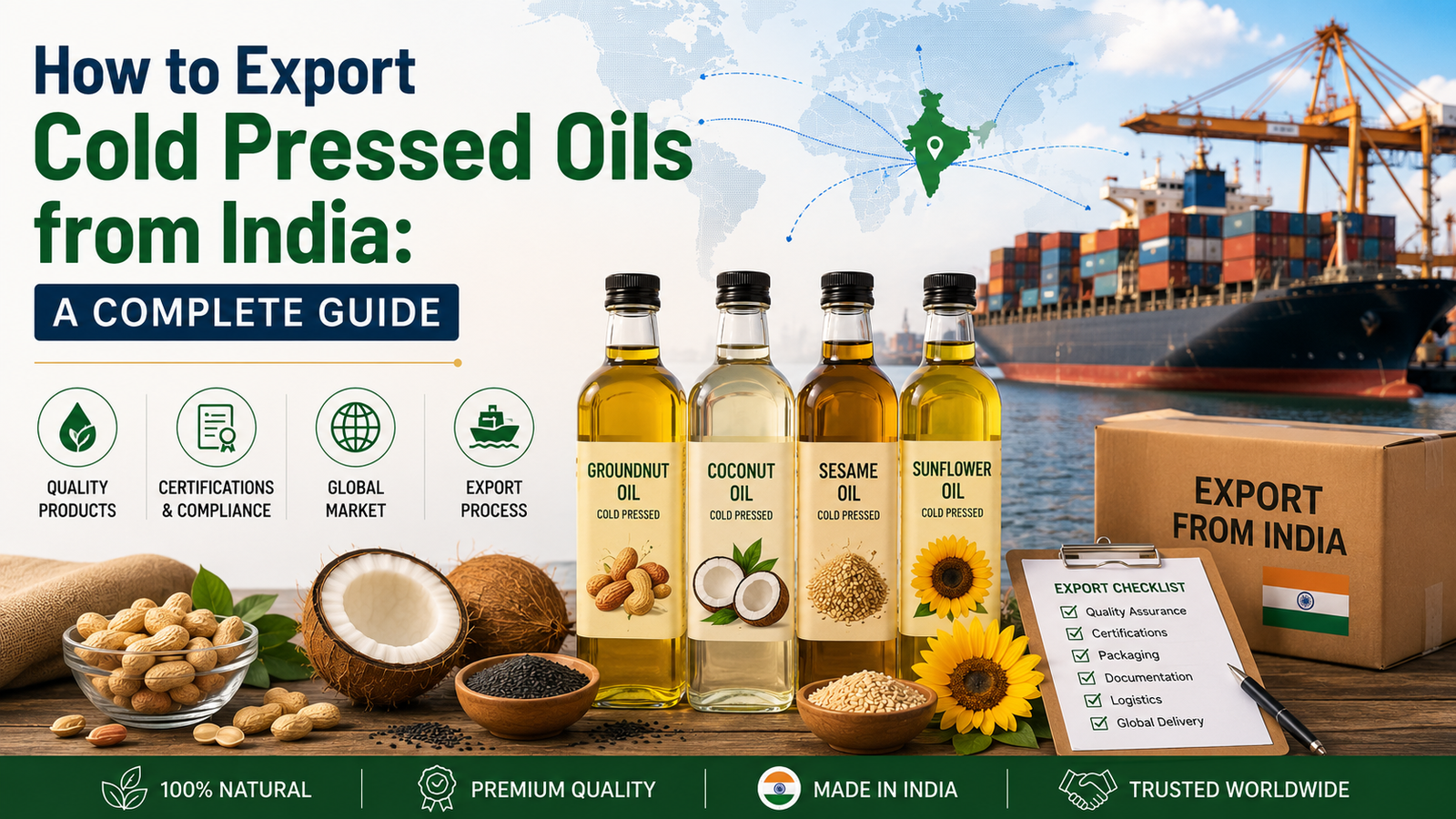
India has long been a powerhouse in the production of natural oils. From the fertile plains of Rajasthan to the coconut groves of Kerala, the country produces an extraordinary variety of cold-pressed oils — groundnut, sesame, coconut, mustard, castor, black seed, and more. With the global health and wellness market booming, international demand for authentic, chemical-free cold-pressed oils from India has never been higher.
If you are a producer, trader, or entrepreneur looking to tap into this opportunity, this guide walks you through everything you need to know to successfully export cold-pressed oils from India.
What Are Cold-Pressed Oils, and Why Are They in Demand?
Cold-pressed oils are extracted by mechanically pressing seeds, nuts, or fruits at low temperatures—typically below 50°C—without the use of heat or chemical solvents. This method preserves the oil’s natural nutrients, flavor, aroma, and antioxidants, making the end product far superior to refined oils.
Global consumers, especially in Europe, North America, the Gulf, and Southeast Asia, are actively shifting toward natural and organic food products. Cold-pressed oils fit perfectly into this trend. They are prized in the organic food industry, the natural cosmetics sector, and the alternative health market. For Indian exporters, this presents a massive, growing opportunity.
Step 1: Identify Your Oil and Target Market
Before anything else, decide which cold-pressed oil you intend to export and to which markets. Some of the most in-demand cold-pressed oils from India include:
- Sesame oil — popular in Japan, South Korea, and the Middle East
- Coconut oil — high demand in the USA, UK, and Australia
- Groundnut (peanut) oil — strong markets in Europe and Southeast Asia
- Mustard oil — widely used across South Asia and increasingly in Europe
- Castor oil — major industrial and cosmetic demand globally
- Black seed (kalonji) oil — growing demand in the Middle East and health markets worldwide
Research your target market’s import regulations, consumer preferences, labelling requirements, and certification expectations before committing to a product-market combination.
Step 2: Set Up Your Business and Obtain Registrations
Exporting from India requires several mandatory registrations and licenses. Here is what you need:
Import Export Code (IEC): This is the most fundamental requirement. Issued by the Directorate General of Foreign Trade (DGFT), the IEC is a 10-digit code that every Indian exporter must have. You can apply online at the DGFT portal with your PAN, bank details, and business documents.
FSSAI Licence: Since cold pressed oils are food products, you must be registered and licensed under the Food Safety and Standards Authority of India (FSSAI). An Export FSSAI license (Central Licence) is required for exporters.
GST Registration: You must be registered under the Goods and Services Tax framework. Exports are zero-rated under GST, meaning you can claim refunds on input taxes.
APEDA Registration: The Agricultural and Processed Food Products Export Development Authority (APEDA) oversees the export of agricultural and processed food items, including edible oils. Registration with APEDA is mandatory for accessing export incentives and schemes.
RCMC (Registration-cum-Membership Certificate): Issued by APEDA or other export promotion councils, the RCMC is required to avail export benefits under the Foreign Trade Policy.
Step 3: Ensure Product Quality and Certifications
Quality is everything in the international oil market. Buyers abroad are sophisticated, and regulatory authorities in importing countries carry out rigorous inspections. To succeed, your cold pressed oils must meet stringent quality standards.
Quality Parameters to Monitor:
- Free Fatty Acid (FFA) content
- Moisture and impurity levels
- Peroxide value (indicates oxidation/rancidity)
- Colour, clarity, and odour
- Absence of adulterants or contaminants
- Heavy metal content within permissible limits
Key Certifications That Boost Export Prospects:
- Organic Certification (NPOP / NOP / EU Organic): If you are targeting the organic segment — which commands premium prices — get certified under India’s National Programme for Organic Production (NPOP) or the US NOP standard. The EU has its own organic regulation. Agencies like ECOCERT, Control Union, and IMO certify Indian producers.
- ISO 22000 / HACCP: Food safety management system certifications that build buyer confidence.
- Kosher and Halal Certifications: Essential for markets in Israel, the USA’s Jewish community, the Middle East, and Southeast Asia’s Muslim-majority countries.
- GMP (Good Manufacturing Practices): Demonstrates that your production follows hygienic and standardised processes.
Getting your product tested at a NABL-accredited laboratory before shipment is strongly recommended. Popular labs include SGS, Intertek, and FSSAI-approved testing facilities.
Step 4: Understand the HS Codes and Export Regulations
Each type of oil has a specific Harmonised System (HS) code, which determines the applicable export duties, import tariffs in destination countries, and documentation requirements.
Some common HS codes for cold pressed oils:
- Sesame oil: 1515 50
- Coconut oil: 1513 11 / 1513 19
- Groundnut oil: 1508 10 / 1508 90
- Mustard oil: 1514 11 / 1514 19
- Castor oil: 1515 30
Check the current export policy on the DGFT website, as some oils may occasionally fall under restricted or canalised categories requiring additional approval.
Step 6: Packaging, Labelling, and Storage
Packaging cold pressed oils for export requires both compliance and marketability in mind.
Packaging Materials: Use food-grade materials that protect the oil from light, heat, and oxidation. Dark glass bottles, food-grade HDPE containers, tinplate cans, and aluminium pouches are commonly used. Nitrogen flushing can extend shelf life significantly.
Standard Export Pack Sizes: Depending on the buyer, you may ship in bulk (200-litre drums or flexi tanks for industrial buyers) or in consumer packs (100ml to 5 litres for retail buyers).
Labelling Requirements: Each importing country has specific labelling norms. At a minimum, labels must include:
- Product name and type of oil
- Net weight or volume
- Country of origin (“Product of India”)
- Manufacturing date and best before date
- Nutritional information (required in USA, EU, and many other markets)
- Certifications logos (Organic, Kosher, Halal, etc. as applicable)
- Importer name and address (usually added by the buyer in the destination country)
Storage: Cold pressed oils are sensitive to heat and light. Maintain storage temperatures between 15°C and 25°C and keep them away from direct sunlight to preserve quality during warehousing and transit.
Step 7: Logistics, Shipping, and Documentation
Choosing the Right Incoterm: Negotiate clear trade terms with your buyer. Common Incoterms used in oil exports include FOB (Free on Board), CIF (Cost, Insurance and Freight), and CFR (Cost and Freight). FOB is the most common starting point for new exporters.
Freight Forwarder: Partner with a reputable freight forwarder who has experience in food and edible oil exports. They will handle customs clearance, container booking, and coordinate with the shipping line.
Key Export Documents:
- Commercial Invoice
- Packing List
- Bill of Lading (for sea freight) or Airway Bill (for air freight)
- Certificate of Origin (issued by FIEO or Chamber of Commerce)
- Phytosanitary Certificate (if required by the destination country)
- FSSAI Health Certificate
- Certificate of Analysis (COA) from an accredited laboratory
- Organic Certificate (if applicable)
- Fumigation Certificate (for wooden pallets)
Major Indian ports handling agri and food exports include Nhava Sheva (JNPT) in Mumbai, Chennai Port, Mundra Port, and Kandla Port.
Step 8: Avail Export Incentives and Government Support
The Indian government offers several schemes to support exporters:
- RoDTEP (Remission of Duties and Taxes on Exported Products): Refunds embedded taxes and duties on exported goods.
- MEIS/RoSCTL (now transitioned to RoDTEP): Earlier schemes replaced by RoDTEP.
- Export Credit Guarantee Corporation (ECGC): Provides credit insurance to protect against payment default by overseas buyers.
- Market Development Assistance (MDA) and Market Access Initiative (MAI): APEDA-administered schemes that partially fund participation in trade fairs and market promotion activities.
- Priority Sector Lending: Exporters can access preferential credit from banks for pre- and post-shipment finance.
How Standard Cold-Pressed Oil Can Find Buyers & Market for Export
Your Strengths to Lead With
Standard Cold Pressed Oil is a successfully growing Indian company with its manufacturing unit in Madurai . It uses no chemical or solvent extraction process, preserving the nature, taste, aroma, and nutritional properties of its products. The brand is trusted by over 50,000+ happy customers across India, holds a 4.7-star Google rating, is FSSAI certified, and lab tested. These are powerful credentials to pitch to international buyers.
How Standard Cold Pressed Oil Can Approach Buyers for Export Orders
Expanding into international markets requires a structured approach. As a trusted manufacturer of premium cold-pressed oils, Standard Cold Pressed Oil can attract global buyers by following these proven strategies.
Dear Sir/Madam,
Greetings from Standard Cold Pressed Oil.
We are a leading manufacturer and exporter of 100% natural cold-pressed oils based in Erode, Tamil Nadu, India. Our oils are produced using the traditional cold-press extraction method without chemicals or solvent extraction, preserving their natural aroma, taste, and nutritional value.
We offer a wide range of premium products, including:
- Cold Pressed Groundnut Oil
- Cold Pressed Sesame Oil
- Cold Pressed Coconut Oil
- Cold Pressed Sunflower Oil
- Cold Pressed Mustard Oil
- Other edible and specialty oils
Why Choose Standard Cold Pressed Oil?
- Manufacturing Unit in Erode, India
- 100% Natural & Chemical-Free Products
- Traditional Cold-Pressed Extraction
- FSSAI Certified
- Lab Tested Quality
- Trusted by 50,000+ Happy Customers
- 4.7-Star Google Rating
- Bulk Supply & Private Label Manufacturing
- Export-Ready Packaging
We are currently looking to establish long-term partnerships with importers, distributors, wholesalers, retailers, and private label brands worldwide.
We would be pleased to share our product catalog, pricing, packaging details, certifications, and samples for your evaluation.
If you are interested, please let us know your product requirements and destination country. We look forward to discussing how we can support your business with high-quality cold-pressed oils from India.
Thank you for your time and consideration. We look forward to hearing from you.
Best Regards,
Sales Team
Standard Cold-Pressed Oil
Manufacturing Unit: Erode, Tamil Nadu, India
Website: www.standardcoldpressedoil.com
Conclusion
Exporting cold-pressed oils from India is a rewarding business opportunity backed by India’s rich agricultural heritage, competitive production costs, and growing global demand for natural, healthy food products. Success requires careful planning — from product selection and quality assurance to regulatory compliance, buyer outreach, and efficient logistics.
Start small, build relationships, earn certifications, and scale systematically. The world is increasingly looking for what India’s soil and traditional extraction methods naturally produce. With the right groundwork, your cold-pressed oil business can find a profitable and lasting place in the global market.
